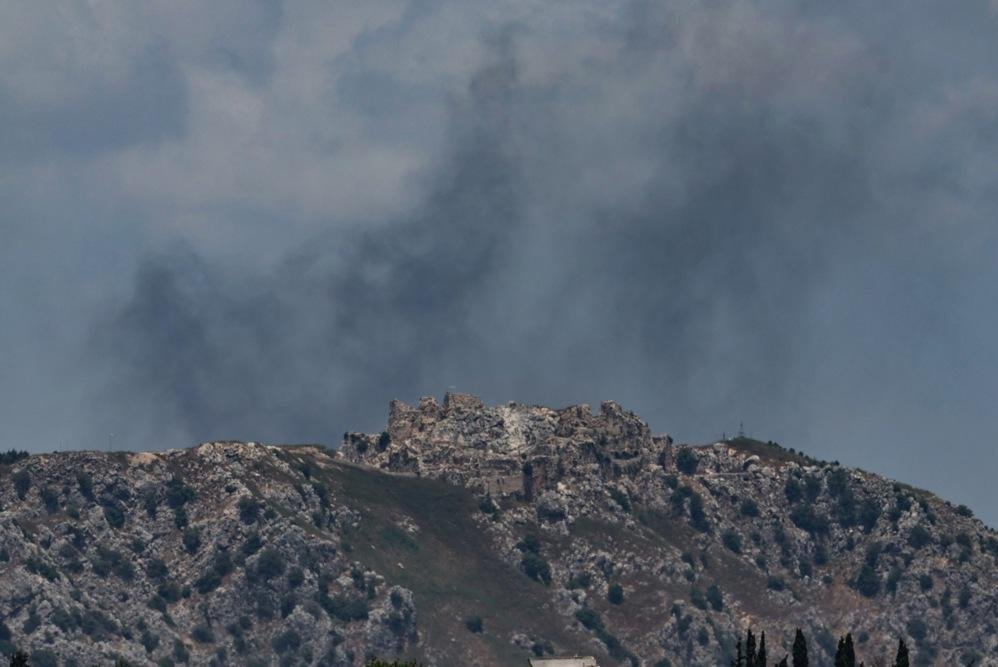
Smoke rises after an Israeli strike next to the Crusader-period Beaufort Castle, as seen from the Israeli side of the border in the Upper Galilee, northern Israel, in June. File Photo by Atef Safadi/EPA
BEIRUT, Lebanon, July 31 (UPI) — Lebanese President Joseph Aoun condemned Israel on Friday for targeting infrastructure and archaeological sites that UNESCO recently added to its World Heritage List and the List of World Heritage in Danger.
Aoun said such violations constitute “a highly dangerous escalation” and threaten progress of negotiations between the two countries.
He was referring to massive explosions near the historic Beaufort Castle, where Israeli officials said they used 700 tons of explosives to destroy Hezbollah’s underground tunnel network.
Aoun said in a statement that, according to the National Center for Geophysics, the explosions generated ground tremors equivalent to a 3.8-magnitude earthquake on the Richter scale, describing them as “a highly dangerous escalation and a blatant violation of existing commitments” with Israel.
He said the Israeli “aggressions” occurred just days before a new round of direct negotiations between Lebanon and Israel was scheduled to take place in Rome on Tuesday and Wednesday.
They are to be aimed at continuing discussions on the implementation of the U.S.-brokered framework agreement reached by the two countries June 26.
Aoun said the timing sent “negative messages” and hindered international efforts to consolidate stability in southern Lebanon. He called on the United States as the sponsor of the framework agreement and the international community to “put an end to these violations that threaten the prospects for progress on the diplomatic track.”
The preliminary framework agreement provides for a phased Israeli withdrawal from occupied areas of southern Lebanon to allow the Lebanese Army to deploy, “restore effective sovereign authority,” disarm Hezbollah and prevent the group from returning to areas evacuated by Israel.
The implementation process began July 21, when the Lebanese Army started deploying in the village of Zawtar al-Gharbieh — the first pilot zone — situated in the central sector of southern Lebanon near the strategic Litani River.
Aoun warned that Israel’s continued violations, aggressions and explosions were causing considerable damage and threatening the safety of residents in most villages across southern Lebanon.
The National Center for Geophysics said it had not detected any earthquakes after the explosions, and that it continues to monitor seismic activity around the clock.
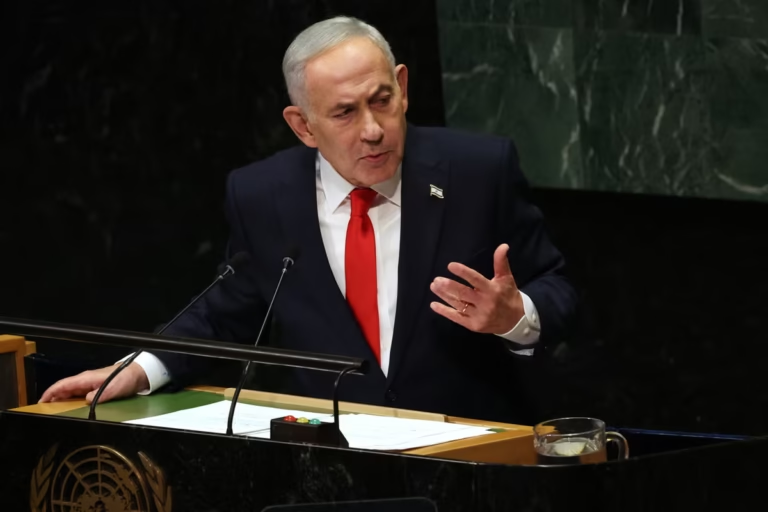
Israeli Prime Minister Benjamin Netanyahu and Defense Minister Israel Katz said in a joint statement early Friday that the Israeli Army had destroyed tunnels in the Beaufort area using approximately 700 tons of explosives. This came in response to what they described as Hezbollah’s violations of the cease-fire agreement.
The statement, published by the Israeli English-language Ynet website, warned that “any attempt by Hezbollah to harm” Israeli Army forces “will be met with a severe and powerful response that will exact a heavy price from the terror organization.”
The Israeli Army said its forces destroyed a significant portion of the “strategic” underground tunnel network built over two decades by Hezbollah and constructed on several levels, some 3.7 miles from the Israeli border.
The explosions came after Israel accused Hezbollah of launching an explosive drone that struck an Israeli bulldozer on Ali Taher Ridge in southern Lebanon on Wednesday night. The Iran-backed group did not comment.
The Lebanese Culture Ministry said in a statement that the vibrations generated by the Israeli explosions may have caused damage in the vicinity of the Beaufort castle; however, the full extent of any damage cannot be assessed without a direct field inspection.
The statement noted that “the location is under occupation,” preventing specialized technical teams from reaching the site and conducting the necessary assessment.
The Beaufort Castle was among five fortified sites located across the historic region of Jabal Amel in southern Lebanon that were added by UNESCO to its World Heritage List and the List of World Heritage in Danger six days before the Friday’s huge explosions.
The sites, which also include Toron Castle, Dubieh Castle, Maron Castle and Chama’ Castle, occupy prominent hilltops and strategic ridges overlooking major regional routes, forming an integrated defensive and administrative network that controlled movement, communication and agricultural resources across a vast territory.
Developed between the medieval period and the 19th century, they illustrate successive phases of occupation and adaptation by Crusader, Ayyubid, Mamluk, Ottoman and local feudal rulers.
On Monday, the U.N. peacekeeping force, or UNIFIL, said its teams safely neutralized nearly four tons of mainly ammonium nitrate explosives discovered during a routine patrol near the Israeli-occupied border town of Houla on July 2.
About the Author