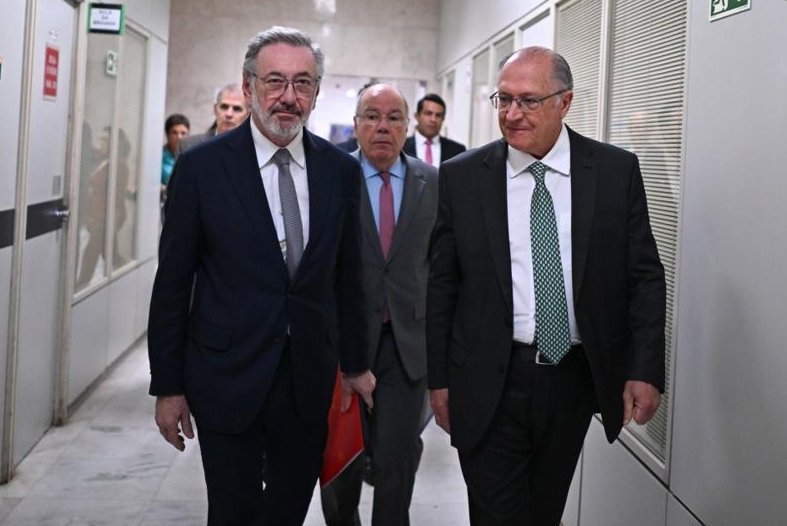
Brazilian Minister of Development, Industry and Trade Marcio Elias Rosa (L), Foreign Minister Mauro Vieira (C) and Vice President Geraldo Alckmin arrive for a press conference at the Ministry of Development, Industry and Trade in Brasilia, Brazil, on July 16. Vieira said the new 25% U.S. tariff on certain Brazilian imports was imposed after Brazil refused demands to give U.S. companies exclusive access to sectors of the Brazilian economy. Photo by Andre Borges/EPA
July 29 (UPI) — Brazil on Saturday will implement the free trade agreement between the Southern Common Market, or Mercosur, and Singapore — the bloc’s first trade agreement with a Southeast Asian country.
The pact will grant duty-free access to all Brazilian exports to that market from the first day it takes effect.
The agreement, signed in December 2023, covers trade in goods and services, investment, government procurement, intellectual property, rules of origin and trade facilitation.
Brazilian Vice President and Minister of Development, Industry, Trade and Services Geraldo Alckmin said President Luiz Inácio Lula da Silva signed the Mercosur-Singapore agreement, describing it as the bloc’s first trade deal aimed at the Asian market.
In a post on X, Alckmin said the agreement will enter into force with 100% of tariff lines for Mercosur exports becoming duty-free, adding that “no one can stop Brazilian foreign trade.”
The agreement aims to establish a common framework to reduce trade barriers and simplify customs procedures between the parties.
Under the terms of the treaty, Singapore will immediately eliminate tariffs on 100% of products originating from Mercosur.
For its part, the South American bloc will gradually eliminate tariffs on approximately 95.8% to 96% of tariff lines from Singapore over a period of up to 15 years, though some of those products will be tariff-free when the agreement takes effect.
Among Brazil’s main exports to Singapore are refined petroleum products and crude oil.
The city-state is one of the world’s leading hubs for refining, storing and distributing hydrocarbons, as well as a major logistics center for trade in Asia, facilitating the distribution of goods to other markets across the region.
Mercosur, made up of Argentina, Brazil, Paraguay and Uruguay, negotiates trade agreements jointly as a customs union. Although the treaty was signed by the bloc, its entry into force depends on each member state completing its own domestic ratification procedures.
Paraguay brought the agreement into force Feb. 1, while Uruguay did so March 1.
The agreement comes amid growing trade tensions between the United States and Brazil after Washington imposed new tariffs on some Brazilian exports.
However, the Mercosur-Singapore agreement was negotiated and signed before the current trade dispute between the two countries.
About the Author