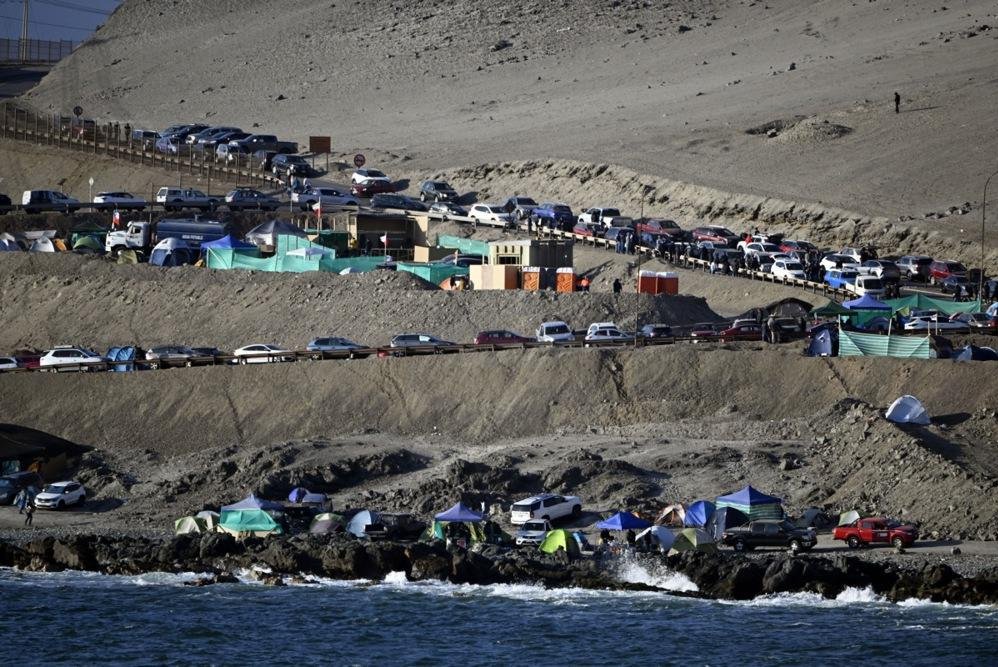
Analysts say these investments in planned Chilean copper mines respond to sustained growth in global demand, driven by electrification, power grids and the energy transition File Phot by Pedro Tapia/EPA
SANTIAGO, Chile, March 20 (UPI) — Mining companies BHP and U.S.-based Freeport-McMoRan submitted two copper projects worth more than $12.5 billion combined to Chile’s Environmental Impact Assessment System, marking one of the clearest signs of a revival in mining investment in the country.
BHP, through Minera Escondida, the world’s largest copper producer, submitted the “Nueva Concentradora Escondida” project valued at $5 billion, which would allow it to continue operations by replacing the Los Colorados plant. That plant is at the end of its useful life.
The project includes an ore processing capacity of 460 thousands of tons per day in the Antofagasta region. If approved, it would begin operations between 2031 and 2032.
Minera El Abra, the Chilean subsidiary of Freeport-McMoRan, is seeking to invest $7.5 billion to extend its operations by 40 years and increase its production by more than 300,000 metric tons of copper annually starting in 2033, once it becomes operational.
The initiative includes the construction of a concentrator plant, a desalination facility, among other projects.
Analysts say these investments respond to sustained growth in global copper demand, driven by electrification, power grids and the energy transition, although they also note that they are being accelerated by a shift in the local political environment after the arrival of a government led by José Antonio Kast.
As one of its first measures, the administration introduced the National Reconstruction Bill, which includes initiatives to reduce bureaucracy and streamline permitting.
The proposal includes lowering the corporate tax rate from to 23% from 27% to align it with countries in the Organization for Economic Cooperation and Development.
Finance Minister Jorge Quiroz told local media this week that the government aims to offer clear rules, legal certainty and an agile, non-discriminatory process that respects the environment.
“This investment will move forward smoothly,” he said, referring to the Escondida project.
The president of the Chilean Mining Chamber, Manuel Viera, said about $18 billion in projects are stalled due to bureaucratic hurdles in the permitting process.
“And in just one week, the president of the republic has indicated that they should be unlocked. That is a sign that signal has been well received by investors, and we expect news like those of Escondida and El Abra to continue in the coming months because Chile also needs more and better mining,” he said.
Cristian Cifuentes, senior leader of studies and content at the Center for Copper and Mining Studies, or Cesco, told UPI that the announcements represent a clear indication of a revival in mining investment, although the trend already had been emerging without such concrete evidence.
“It is a validation of Chile as a competitive jurisdiction in a highly capital-intensive global context,” he said.
He added that while investment decisions respond to global copper demand, their execution depends “critically on local conditions: permitting, institutional stability and political signals.”
“Any improvement in regulatory certainty or pro-investment narrative accelerates decisions that, in many cases, were already in the pipeline. At the same time, these filings show that, despite recent regulatory tensions, the country maintains baseline conditions that allow investment decisions to move forward,” he said.
Víctor Frangi, managing director of Delivery & Transformation at KPMG Chile, said the country is creating more favorable conditions to activate projects, in an environment in which copper demand is projected to increase by about 40% by 2040.
“Chile approved the Framework Law on Sectoral Authorizations, which seeks to reduce permitting times by between 30% and 70%, along with the modernization of the Environmental Impact Assessment System regulations to focus evaluations on projects with significant impact,” he said.
Frangi said that Chile now offers greater business certainty and a more limited level of risk, which facilitates large-scale investment decisions.
Analysts warn, though that growing regional competition to attract mining investment exists.
“Countries such as Argentina have improved their macroeconomic environment and promoted initiatives such as the Incentive Regime for Large Investments, positioning themselves to attract large-scale projects, such as Vicuña, a joint venture between Lundin Mining and BHP, with an estimated investment of $18 billion,” Frangi said.
He added that Peru and even the Democratic Republic of Congo also show dynamism.
“Chile faces the challenge of remaining competitive against other destinations that are also capturing investment. There are replacement and efficiency projects, such as the new Escondida concentrator, and changes in the operating model, such as the advance of desalination as a standard in water use,” Frangi said.
Viera said mining companies are seeking more copper deposits amid growing global demand.
He added that armed conflicts between the United States and Iran, as well as between Russia and Ukraine, have disrupted the balance between supply and demand.
“They have broken the balance of supply and demand. As armed conflicts increase, demand rises for critical minerals used in weapons manufacturing. These are factors driving the search for copper, iron and other minerals, in addition to demand linked to the development of technologies associated with climate change,” he said.
About the Author