A political lobbying firm founded by the former electoral strategist for David Cameron and Boris Johnson secretly pays journalists to write pieces for British newspapers that are favourable to their clients, a Guardian investigation can reveal.
In a practice that appears to create a backdoor for private companies to influence public opinion, lobbyists for CT Group – co-founded by the campaign strategist, Lynton Crosby – told an undercover reporter that they had paid journalists to place apparently independent stories in newspapers.
They offered hundreds of pounds in cash incentives to do so for a property industry client and said the deal would grant the lobbying firm increased editorial control.
The Guardian began investigating the arrangements after Gavin Stollar, head of CT’s real estate division, approached a freelance journalist and offered to pay him to pitch a piece to a British national newspaper about problems caused for the housebuilding industry by the Building Safety Regulator, set up in the wake of the Grenfell Tower fire, a tragedy that claimed the lives of 72 people.
Stollar hoped the journalist would write about the human consequences of the UK’s housing shortage and suggest the regulator was making the situation worse. Stollar, a Liberal Democrat activist who was awarded an OBE in 2024, said CT Group would help with research and provide human case studies of people affected by the housing shortage.
Stollar led the journalist to understand that while they would be paid by the newspaper for apparently independent reporting, they would also be paid by CT Group, which has property industry clients.
Other CT Group staffers then proposed the freelance journalist could be paid to write stories for newspapers as part of its work for a leading property guardianship company, Live-In Guardians. One said: “You can do it either way. We don’t have to pay you, and you just go off and do how you normally do. Or, we can pay you, but we get more control over it.” They then offered him “£100 for every story that is successfully published (national or trade)”.
In meetings with the reporter, the CT Group employees proposed he chair a roundtable for the company for £500 and pitch pieces to national and trade papers that would support the guardianship sector – which sometimes has a reputation for low quality housing with few protections for residents. One suggestion was to write “a call to action from the industry for [Andy] Burnham to be smart about this”.
They said they did not want pieces to appear like advertorials – which are transparently signposted paid-for editorial pieces – “but clearly we’d like you to keep our client’s messaging and overall objective in mind”.
In a statement, CT Group said the events had been “deliberately mischaracterised”. They said they did not engage the undercover journalist to do anything and did not pay him anything.
CT Group is a £40m-a-year turnover lobbying company whose recent clients include Airbus Defence and Space, the tobacco company Philip Morris and the owner of Manchester City football club. It has a global workforce of 150 staff and describes having achieved results for clients “on corporate issues, general elections, reputational transformation and legislative reform”.
It is part of an industry of public affairs and political consulting firms facing growing scrutiny after Peter Mandelson’s dual role as an owner of the lobbying company Global Counsel while he served as British ambassador to Washington. Last week the Ethics and Integrity Commission demanded new laws to improve transparency, after a review ordered by Sir Keir Starmer.
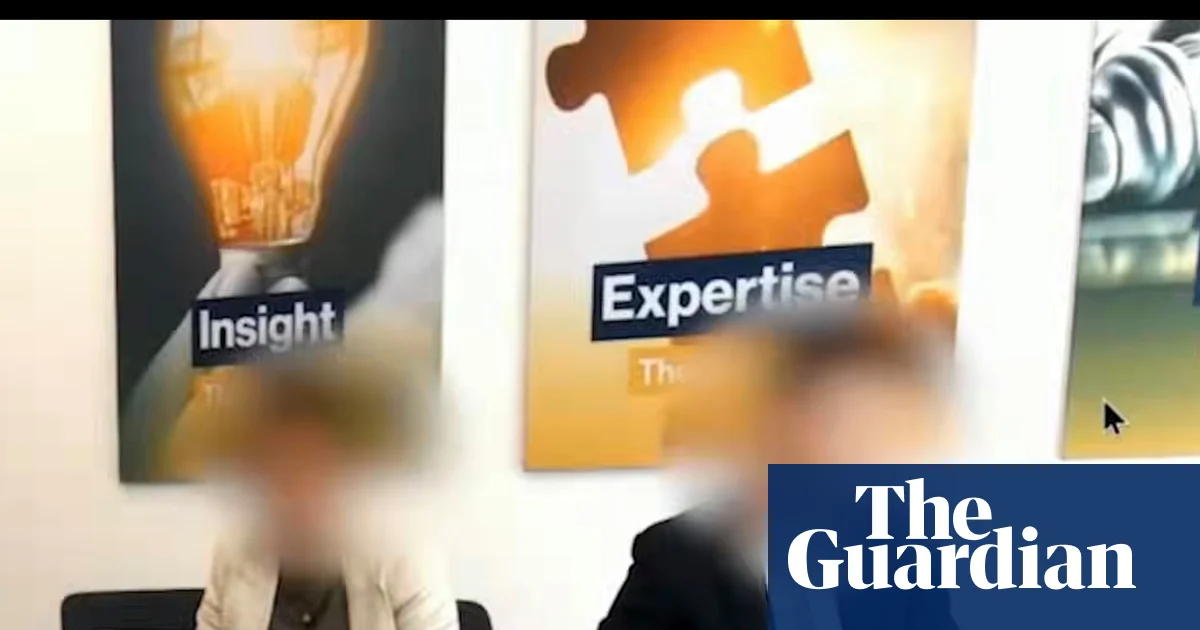
The investigation spanned more than four months and involved discussions in person, on video conference calls, and over email, that touched on placing stories in newspapers including the Financial Times and the Guardian.
When the undercover reporter said he would feel “discomfort” at “being paid to write something with the newspaper not knowing” one lobbyist said: “I completely understand that, but I also think if you were to tell [the editor] ‘CT has commissioned me to do this’, she would instantly bat it out of the room. She wouldn’t … I think you’d be hard pressed to find an editor who [would].”
During the same meeting the journalist noted that he would ordinarily be paid by a publication, but asked: “Is there a sort of financial arrangement with CT Group as well?”
“Yeah,” a CT manager replied. “Historically, yeah.”
In a subsequent call, another lobbyist said CT Group had since worked with a journalist “where I paid her to do a certain piece, a certain national piece”, but the journalist “never discloses to editors where she gets her sources from”. They described the financial arrangement with this unnamed journalist as “a retainer”.
In a statement, CT Group said: “We do not comment publicly on work we do for clients and we therefore cannot respond to the specific allegations you have made.” They said the events had been “deliberately mischaracterised” and said they did not engage the undercover journalist to do anything and did not pay him anything. They said the journalist was looking for work and “chased us relentlessly over a period of more than six months”.
“We are happy to confirm, however, that we never ask journalists to behave otherwise than in accordance with their professional and ethical standards, and we trust journalists to conduct themselves by reference to those standards,” they said. “We note it is commonplace for journalists to chair or participate in roundtable and similar events, and to provide other media services to their clients, and we support the right of journalists to do so.”
The lobbyists delegated to speak to the journalist did not always seem comfortable with paying to place stories. One, who had recently joined, said it seemed “a bit weird to me”, but she said if a payment was made, CT Group would need to see the story before it was submitted to a national newspaper “because you’re paying them to achieve an outcome of a piece.”.
Asked about the input CT Group would have over his story, another said: “The commercial relationship very much varies, there’s no sort of set formula about it. It’s not like this is how we always operate … it’s a project by project, piece by piece, sort of system.”
Referring to the payment offer, he said “we can 100% take that off the table”. They said: “I can understand you being like, no, I don’t want to work in that way. That’s completely fair. And so happy for this to be a sort of much more traditional relationship.”
CT Group publishes a code of conduct which states that “ethical and professional behaviour is at the heart of CT Group’s business, and those values should be followed at all times”. It says “we never do anything we cannot justify publicly”. In its statement, the CT Group said “we never ask journalists to behave otherwise than in accordance with their professional and ethical standards, and we trust journalists to conduct themselves by reference to those standards”.
The Guardian’s code of practice requires journalists to tell a senior editor of “any attempts to induce favourable editorial treatment through the offer of gifts or favours”, while the FT’s code of conduct states that “no one at the FT should abuse their position for personal profit”.
In a discussion about how he would pitch a piece to the FT or the Guardian, the undercover journalist asked if he would tell the newspaper he was working with CT Group or pitch it as his own story. “I think you’d pitch it in like that,” one of the CT staff members replied.
“So they wouldn’t necessarily know that it kind of had a CT group angle?” the reporter asked.
“No, I don’t think so,” they said. “No, I don’t think they need to. We can help you flesh out the angle and stuff to take to the editor and make sure you’ve got the case studies and stuff. But I don’t think, no, I don’t think … we kind of sit behind that.”
Live-In Guardians was approached for comment.
About the Author