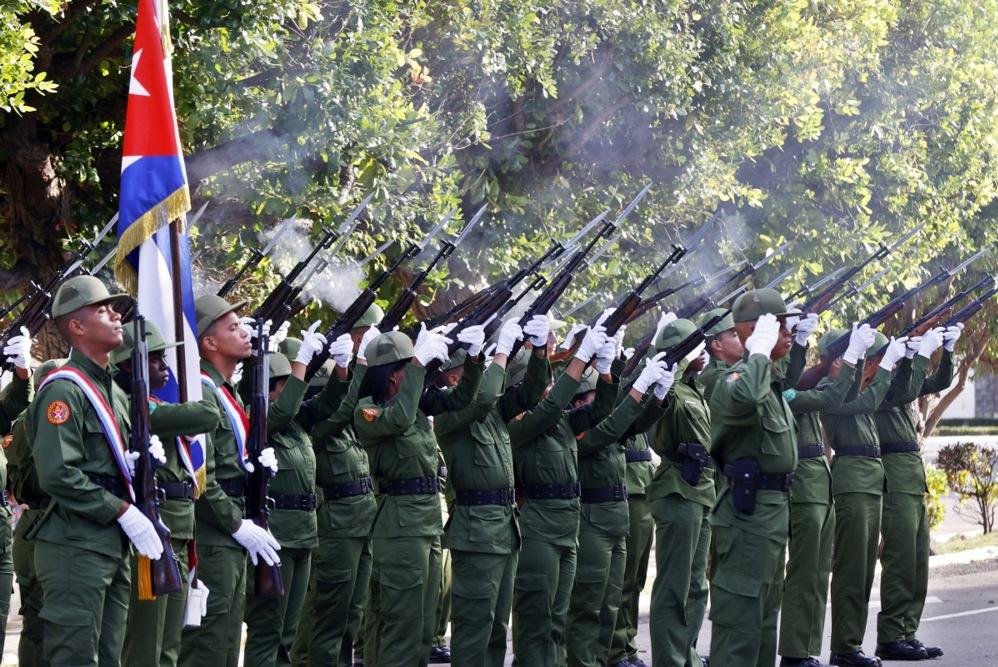
A new report documents at least 97 deaths or disappearances of recruits in the Cuban military between 2001 and 2026 File Photo by Ernesto Mastrascusa/EPA
July 21 (UPI) — Suicide is the leading documented cause of death among young people serving in Cuba’s mandatory military service, according to a report published by the Cuban Citizen Audit Observatory.
The report, issued Monday, documented at least 97 deaths or disappearances of recruits between 2001 and 2026 and warned that the lack of official statistics makes it impossible to determine the true scale of the problem.
Prepared by the independent observatory run by the Cuba Siglo 21 research center, the report found that 34% of the recorded deaths were suicides, surpassing accidents, negligence, homicides and lack of medical care.
Researchers identified 22 suicides in 2025, the highest annual total in the database, with the average age of the victims at 18.7 years old.
In Cuba, mandatory military service is required for most men beginning at age 17. Those who enroll in a university complete one year of service, while the rest serve two years in military units.
According to the report, Cuba has followed the opposite path from most of Latin America, where numerous countries have abolished, relaxed or professionalized military service over recent decades.
Cuba’s system, however, has strengthened its mandatory nature, maintains criminal penalties for those who attempt to evade it and does not recognize conscientious objection.
The researchers also argue that the tightening of recruitment coincides with a shrinking youth population driven by demographic aging and emigration.
According to the report, authorities have relaxed medical and psychological screening criteria to meet recruitment quotas and continue assigning many conscripts to agricultural, construction and maintenance work unrelated to military training.
Ovidio Mirales, who completed two years of mandatory military service after finishing high school, told UPI that the process begins when a military official visits each young man’s home to deliver a summons for a medical evaluation.
“Most of them end up going in. Out of every 10 young men, eight or nine pass the examination and are sent into service,” he said.
According to Mirales, recruits first complete a training period of between 35 and 45 days, known as la previa, during which they receive an olive-green uniform, boots, a backpack and basic instruction in marching, disassembling a rifle and standing guard before being assigned to a permanent unit.
Mirales said military training played a secondary role.
“The main objective wasn’t to learn how to shoot or prepare for war. The goal was for you to work for the government for one or two years without receiving a salary,” he said. “To me, it was like being in prison. The difference was that on some weekends you could go home, but you were required to stay there.”
“At 17, you stop being a teenager and become a soldier,” he said.
During that training period, he shared the unit with about 150 young men from different parts of the country. Among them were two recruits from a rural area who deserted the unit just days after arriving.
“They were gone for about 15 days until the police found them and brought them back. Later, one of them left again, and we never saw him again,” he recalled. “You can’t do that in Cuba. Deserting military service is punishable by law.”
After completing his initial training, Mirales was assigned to the Cuba fire department for two years. There, he met a conscript who had come from a prison unit and who described the conditions faced by young men assigned to guard maximum-security prisons.
“No one was psychologically prepared for that. We were 17 or 18 years old, and they assigned us to guard maximum-security inmates,” Mirales recalled from that conversation.
He said the soldier told him about a recruit with whom he had served in a prison who worked three-hour guard shifts, alternating with only three hours of rest.
“He told me that one day, while he was on duty in a watchtower, he took the AK-47 rifle assigned to him and shot himself in the chest,” Mirales said.
According to the account he received, the young man survived after being taken to a hospital but was later discharged from service and never recovered psychologically from the incident.
The Cuban Citizen Audit Observatory report said that suicide has become the leading cause of death among recruits, and it attributes part of the problem to the enlistment of young people with psychological conditions incompatible with carrying firearms, deteriorating conditions in military units and the absence of independent oversight mechanisms.
The researchers also said that the deaths of conscripts are often surrounded by contradictory official accounts, and that many families face difficulties obtaining independent investigations, forensic reports or information about the circumstances under which their children died.
According to the Cuban Citizen Audit Observatory, the problem extends beyond the mandatory nature of military service and lies in the conditions under which young people fulfill that obligation, the lack of transparency in the system and the absence of effective mechanisms to hold those responsible accountable when tragedies occur.
If you or someone you know is struggling with suicidal thoughts, help is available 24/7. Call or text the 988 Suicide & Crisis Lifeline for free, confidential support. Globally, the International Association for Suicide Prevention has contact information for crisis centers around the world.
About the Author