What if a park was designed not to make walking easier, but to make you think differently? That is the idea behind the Site of Reversible Destiny, one of Japan’s most unusual artistic landmarks. Instead of flat pathways and carefully ordered gardens, visitors encounter sloping hills, tilted buildings, uneven floors, and optical illusions that challenge their senses at every turn. The experience is intentionally disorienting, encouraging people to slow down, pay attention, and rediscover the curiosity of childhood through architecture itself.
Located within Yoro Park in Gifu Prefecture, the Site of Reversible Destiny was conceived by Japanese artist and architect Shusaku Arakawa and American poet and artist Madeline Gins. The pair spent decades developing the philosophy of “reversible destiny,” a concept that questioned whether architecture could change the way people think, move, and even experience life itself. Rather than treating buildings as static objects, they believed environments should constantly stimulate the body and mind. Their ambitious vision became reality when the park opened in 1995, transforming abstract philosophy into an immersive public space unlike any other.
Every element of the park has been carefully designed to surprise visitors. More than 140 interconnected pathways weave through rolling landscapes planted with dozens of tree and plant species that change dramatically with the seasons. Spring brings blooming cherry blossoms, while autumn fills the grounds with brilliant shades of red, orange, and gold. Instead of following predictable routes, guests climb hills, descend into valleys, and navigate winding trails that constantly alter their perspective. The changing terrain ensures that no two visits feel exactly the same.
Advertisement
Advertisement
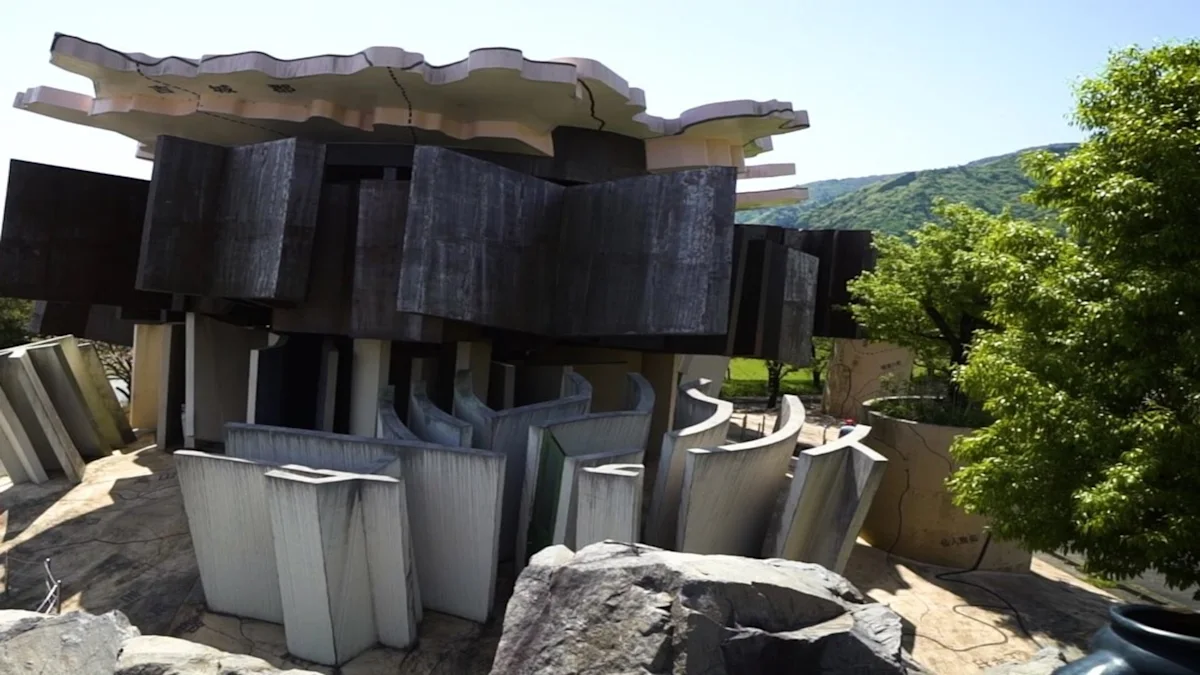
Among the park’s most recognizable attractions is the Critical Resemblance House, an unconventional structure crowned with a rooftop shaped like the map of Gifu Prefecture. Nearby, the Reversible Destiny Office features sloping floors, mirrored ceilings, uneven surfaces, brightly colored walls, and maze-like rooms designed to challenge visitors’ sense of balance and orientation. Throughout the park, architecture becomes something to experience physically rather than simply observe. Even standing still can feel unusual as the surrounding environment continuously shifts visual perception.
The artists wanted people to approach the park with the openness of a child by climbing, exploring, and interacting freely with every structure. Because many areas feature steep inclines, irregular pathways, and unexpected angles, visitors are even offered protective helmets before beginning their journey. Far from being a gimmick, the helmets reflect the park’s philosophy that exploration sometimes requires stepping outside familiar comforts. Every stumble, adjustment, and moment of surprise becomes part of the artistic experience.
Nearly three decades after opening, the Site of Reversible Destiny continues to attract architects, designers, artists, and curious travelers from around the world. It remains one of Japan’s most distinctive examples of experiential art, demonstrating that architecture can do far more than provide shelter.
About the Author