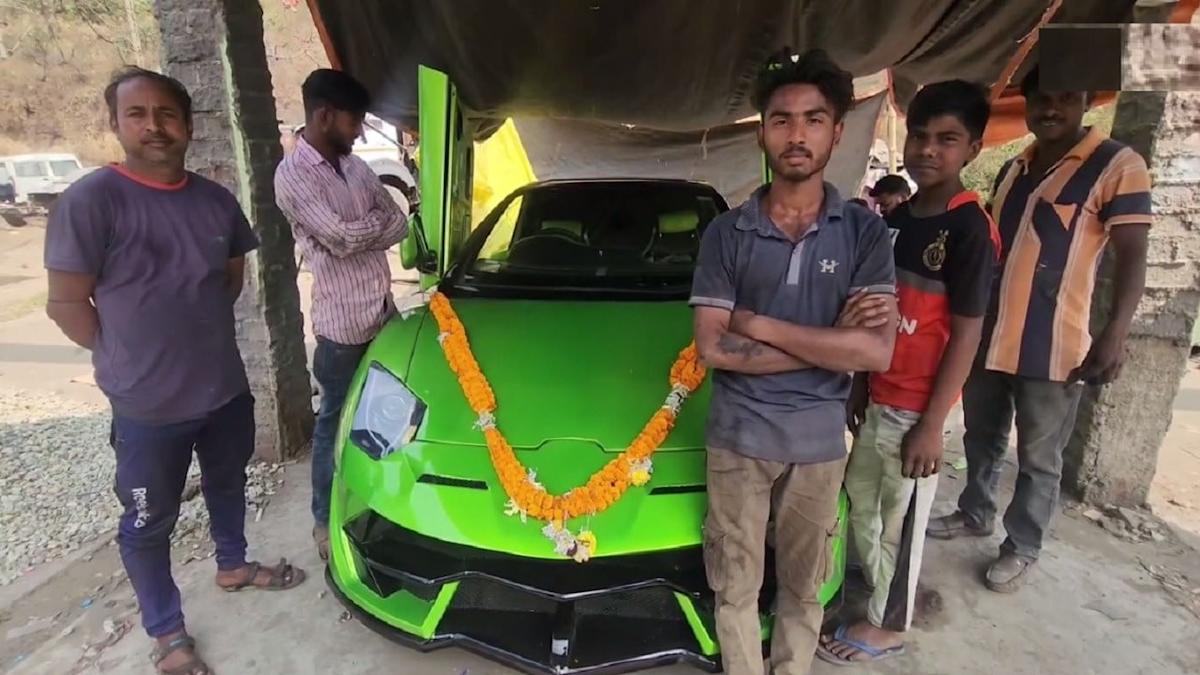
A small hatchback from India is making a lot of noise online right now, and not because of what is under the hood.
A mechanic from Jharkhand, Mohammad Arif, has taken a humble Maruti 800 and transformed it into a Lamborghini-inspired build that is turning heads on social media. The video has been making the rounds for days, pulling in reactions from car enthusiasts, skeptics, and plenty of people who did not expect to see something like this come out of a small workshop.
The headline number is part of what makes it go viral. Reports suggest the build cost around Rs 4 lakh, or roughly $5,000, which is a tiny fraction of what a real Lamborghini would cost. That alone is enough to grab attention. The real story, though, is how it was put together.
Built by Hand, Not a Kit
This was not a bolt-on body kit job. From the videos and reports that have surfaced so far, most of the work appears to have been done by hand. Arif reportedly spent around two years on the build, drawing on roughly a decade of experience as a mechanic.
Panels were cut, shaped, and welded to create a completely new look, transforming the upright, boxy Maruti 800 into something much lower and more aggressive. Reports suggest Arif handled nearly all of the fabrication himself, from body shaping and welding to detailing, with only a few components, such as the music system, LED lights, and front glass, sourced from outside.
The stance has been reworked to sit closer to the ground, with flared wheel arches and a wider footprint helping sell the supercar look. Fiberglass panels were reportedly used to achieve the sharp, angular lines, along with details like a large rear wing, front splitters, and custom LED lighting.
The car now sits on 16-inch wheels instead of the original 12-inch setup, and the bright green paint ties everything together with a look that clearly draws inspiration from Lamborghini’s signature color palette.
Inside, the transformation continues. The interior has been converted into a two-seat layout, and a custom sunroof has been added, something the original Maruti 800 never offered.
Underneath it all, the mechanical reality remains much more modest. The car still runs the original 796cc three-cylinder engine, producing roughly 40 horsepower and 59 Nm of torque. It looks like a supercar, but it still drives like the small city car it started life as.
Arif has reportedly even given the build a name: Tarzan. That feels fitting for a project like this, especially since people who have seen it in person say it tends to stop traffic in the most literal way, with drivers and bystanders taking a second look as it passes.
It Is Not a Lamborghini, and That Is the Point
No, this is not a real Lamborghini. It is not fast, and it is not trying to be something that would fool anyone up close.
That is not really the point.
This build feels less like a replica and more like a tribute. In a way, that actually makes it more interesting than some of the tortured kit cars that try too hard to pass as the real thing. There is no real illusion here. It is a Maruti 800 wearing supercar-inspired styling, and it owns that identity.
That is a big part of why the build works. It respects the fantasy without pretending to rewrite reality. It is not trying to fake Lamborghini ownership. It is taking inspiration from an icon and turning a very ordinary car into something fun.
Respect the Build
A lot of the conversation around this car has been what you would expect. Some people immediately see the creativity. One commenter wrote, “Honestly, for 4 lakhs, he did an awesome job,” while another added, “Yeah, jokes apart, he actually did a good job. Mod culture should be encouraged more.”
Others focused on the reality underneath the looks. One post joked that it is “sheep in wolf’s clothing,” which is fair when talking about performance. Another commenter pointed out that added weight could put extra strain on the small engine, which is also a reasonable observation.
Even some of the more critical voices still gave credit where it was due. One comment summed it up well: “Calling that a stunning replica is a stretch, but I have to appreciate the thought and work.”
That is probably the right way to look at builds like this. Not every car has to be your taste, and not every project has to meet your standards. That does not mean it deserves to be dismissed.
There is real effort here. There is real creativity here. That is something car culture should always make room for.
The reality is simple. It is easier to criticize than it is to create. Anyone can point out flaws, but far fewer people actually pick up tools and build something from scratch.
A healthy car culture depends on that difference. You do not have to love every build or agree with every decision, but supporting the passion behind it is what keeps the entire community moving forward.
This Is What Car Culture Looks Like at Its Best
It is easy to sit back and pick apart something like this. It is not perfect, it is not especially practical, and it is definitely not a Lamborghini. That misses what actually makes it interesting.
At its core, this is exactly what car culture has always been about. It is taking something basic and turning it into something personal, taking something ordinary and making it fun. Even with limited details available, this does not come across like a rushed build thrown together for attention. It looks like a builder taking a humble, overlooked car and putting in the time to make it memorable.
That is the spirit of hot rod culture. For decades, people have been starting with affordable cars and reshaping them into something unique. This is just a modern version of that same idea, showing up in a different part of the world and spreading through social media instead of local car meets.
There is no need to pretend it is a supercar to appreciate it. In some ways, the fact that it is clearly a tribute makes it more interesting. It is creative, a little unconventional, clearly handmade, and built to be enjoyed.
It may not be fast or perfect, but it is exactly the kind of build that keeps car culture interesting.
About the Author