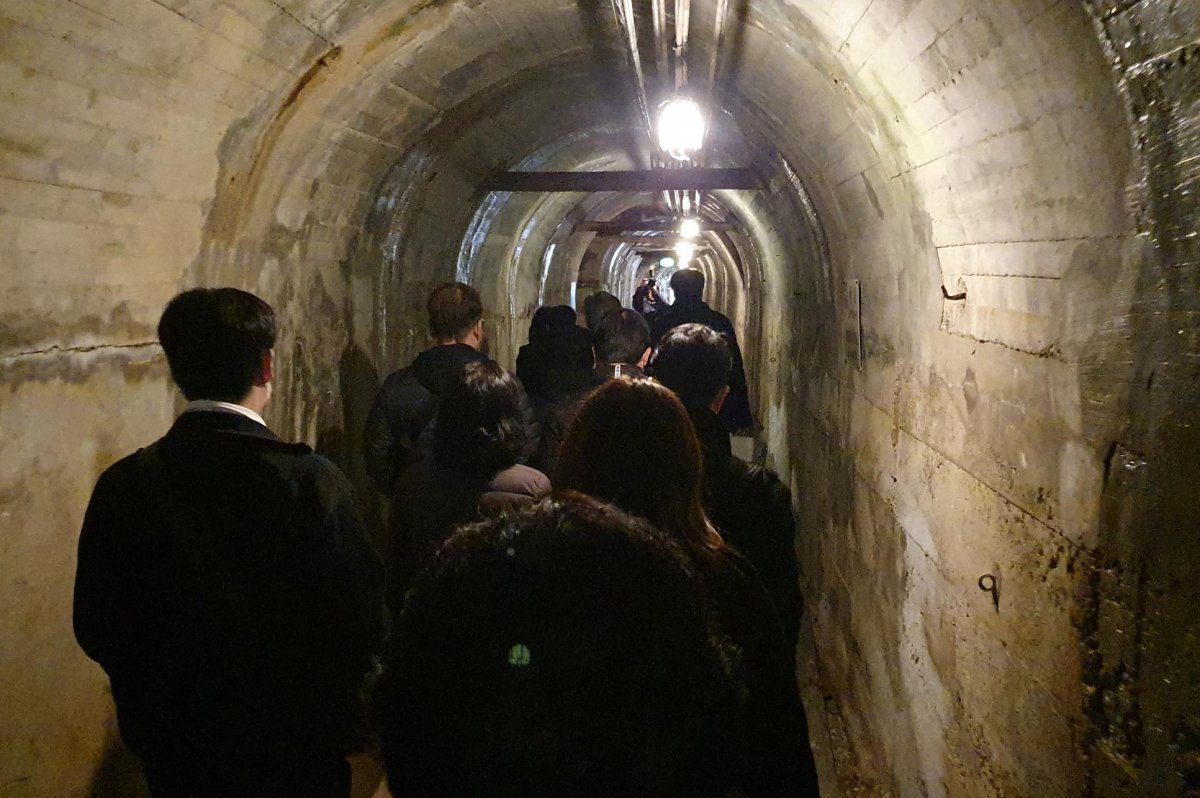
Family members of Korean victims of Japan’s wartime forced labor at the Sado mine complex during World War II explore the mines on Nov. 25, 2024. UNESCO has recommended Japan do more to reflect the “whole history” of the site. File Photo by Yonhap
An international heritage body has recommended that Japan take further steps to adequately reflect the “whole history” of the Sado mine World Heritage site, linked to the wartime mobilization of Korean laborers, saying Tokyo’s related efforts remain insufficient.
The recommendation was included in a draft decision released Wednesday by UNESCO’s World Heritage Committee following its review of a State of Conservation (SOC) report submitted by Japan late last year, according to Seoul’s foreign ministry.
When approving the inscription of the mine as a World Heritage site in July 2024, the committee recommended that Japan present the site’s “whole history” across all periods of mining activity.
South Korean foreign ministry officials said the “whole history” includes the period during which more than 1,500 Koreans were mobilized to work at the mine during Japan’s 1910-45 colonial rule of the Korean Peninsula. Once known for its gold production, the complex was later used to produce war supplies for the Japanese imperial army during World War II.
“The interpretation and presentation strategy of the whole history has shown some progress but remains to be fully developed,” the draft decision read.
“Further clarification is needed regarding how the interpretation and presentation strategy and facilities comprehensively address, at the site level, the whole history of the property throughout all periods of mining exploitation,” it noted.
The committee also recommended that Japan closely consult with relevant parties to improve its interpretation and exhibition strategy and ensure that the site’s whole history is fully presented, and submit a follow-up implementation report by December 2027.
The draft decision is scheduled to be discussed at the 48th committee session in the southeastern South Korean city of Busan next week. Unless objections are raised by member states, it is expected to be adopted by consensus.
“We view the decision as reflecting our consistent position that Japan’s implementation of the committee’s recommendations remains insufficient,” a foreign ministry official said.
“We will continue to work closely with the UNESCO Secretariat and relevant countries to ensure that Japan faithfully implements the committee’s decisions and the commitments it made at the time of the site’s inscription,” the official added.
Japan has held annual memorial ceremonies for workers at the mine as part of commitments made during the inscription process. South Korea, however, has declined to attend the Japan-hosted event for two consecutive years, noting the ceremony failed to adequately reflect the site’s whole history, including the forced mobilization of Korean laborers.
Seoul has instead held separate memorial services each year near the mine site with the bereaved family members of the forced laborers.
Copyright (c) Yonhap News Agency prohibits its content from being redistributed or reprinted without consent, and forbids the content from being learned and used by artificial intelligence systems.
About the Author