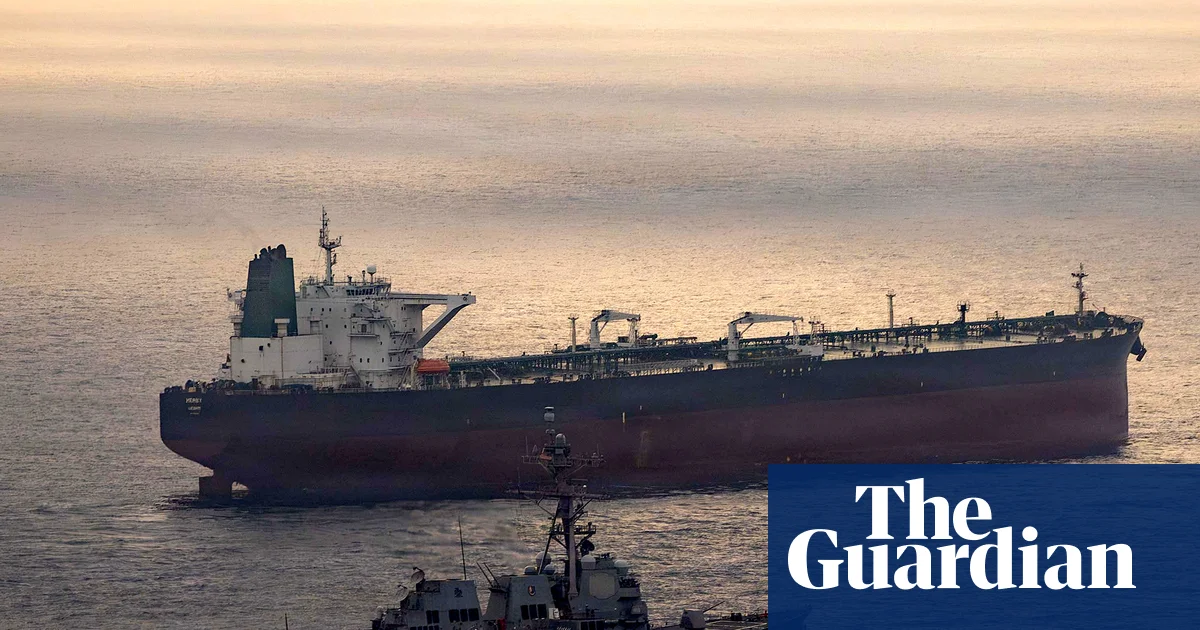
Oil and gas prices have jumped and expectations of interest rate rises in Europe have increased after the US carried out a third night of military strikes against Iran.
Brent crude, the international benchmark for oil prices, rose by as much as 4.6% to $87.08 a barrel on Tuesday, its highest level in just over a month.
The price had risen as much as 10% on Monday after Donald Trump announced a blockade of Iranian shipping, and the US strikes pushed levels even higher on Tuesday.
Gas prices leapt higher, with the Dutch natural gas contract for August delivery, the European benchmark, up nearly 3% to €52.8 a megawatt hour, the highest since early April.
The UK natural gas contract for August delivery climbed 3.3% to 128.27p a therm, the highest level in more than three months.
Fears over higher inflation linked to the oil price rise fed expectations of interest rate rise by the Bank of England and European Central Bank.
For the first time in a month, financial markets priced in a quarter-point UK rate rise by September, likely followed by another one by the end of the year. Traders have also forecast that the ECB will raise rates by a quarter point in September, and another increase by the end of December.
At the start of the month, swaps priced less than a quarter-point rise for the Bank of England and ECB, when a fragile ceasefire was in place between the US and Iran.
The market swings came as Trump said the strait of Hormuz would stay open “with or without Iran” but that the US would start charging fees on ships transiting through the waterway. A 20% fee would be levied “for any and all costs necessary” to provide security and safety for vessels.
The apparent policy reversal has fed fears that there could be further upward pressure on the oil price, which could in turn contribute to higher inflation. Oil was trading at $72.48 a barrel before the US-Israeli strikes on Tehran in late February and reached highs of $120 in April.
Kathleen Brooks, the research director at the broker XTB, said the last blockade of the strait of Hormuz, through which a fifth of the world’s oil supply normally passes, lasted for more than 60 days.
after newsletter promotion
“The prospect of more fighting and a fresh blockade has meant that traffic through the strait has slowed to a near halt,” she said. “Only six cargo ships traversed the strait on Sunday, which is a trickle compared with previous flows in recent weeks. When the supply chain gets gummed up, this is what keeps upward pressure on the oil price.”
UK government bond yields rose to their highest level since May, with the 10-year gilt yield up five basis points to 5.02%. The yield on the two-year gilt, which is particularly sensitive to interest rate expectations, jumped eight basis points to 4.45%, the highest since 19 May.
Stock markets also fell on Tuesday. The UK’s blue-chip FTSE 100 index slipped 0.4%, despite rises in two of its biggest constituents, the oil companies BP and Shell, which were up 2.4% and 1.7% respectively.
The Stoxx Europe 600, which tracks the biggest companies on the continent, dropped 0.5%.
In Asia, stocks were more mixed thanks to a rebound in technology shares. South Korea’s Kospi and Japan’s Nikkei 225 rose 07%, while the Chinese Shanghai Composite was up 1.4%.
About the Author