While Joe Biden feted Jeffrey Donaldson at the White House during St Patrick’s Day celebrations in March 2024 a handful of detectives back home in Northern Ireland were quietly completing the countdown to his unmasking.
Weeks earlier Donaldson had steered the Democratic Unionist party (DUP) back to power-sharing at Stormont, a political feat that rebooted the Good Friday agreement and imbued a statesmanlike aura to his triumphant visit to Washington.
The Lagan Valley MP looked like an accountant and spoke in a passionless monotone – an antithesis to his fire-breathing predecessor Ian Paisley – yet he had brokered a deal with Downing Street over Northern Ireland’s post-Brexit status in the UK and convinced his party to accept it.
But days after his return from the US, on a damp, dark morning, the police swooped on his County Down home and everything Northern Ireland thought it knew about Donaldson imploded.
The Presbyterian family man who wore a fish badge on his lapel to signify his Christian faith was charged with 18 historical sexual offences – one count of rape plus multiple counts of indecent assault and gross indecency against two young victims – and his wife, Eleanor, was charged with aiding and abetting the abuse.
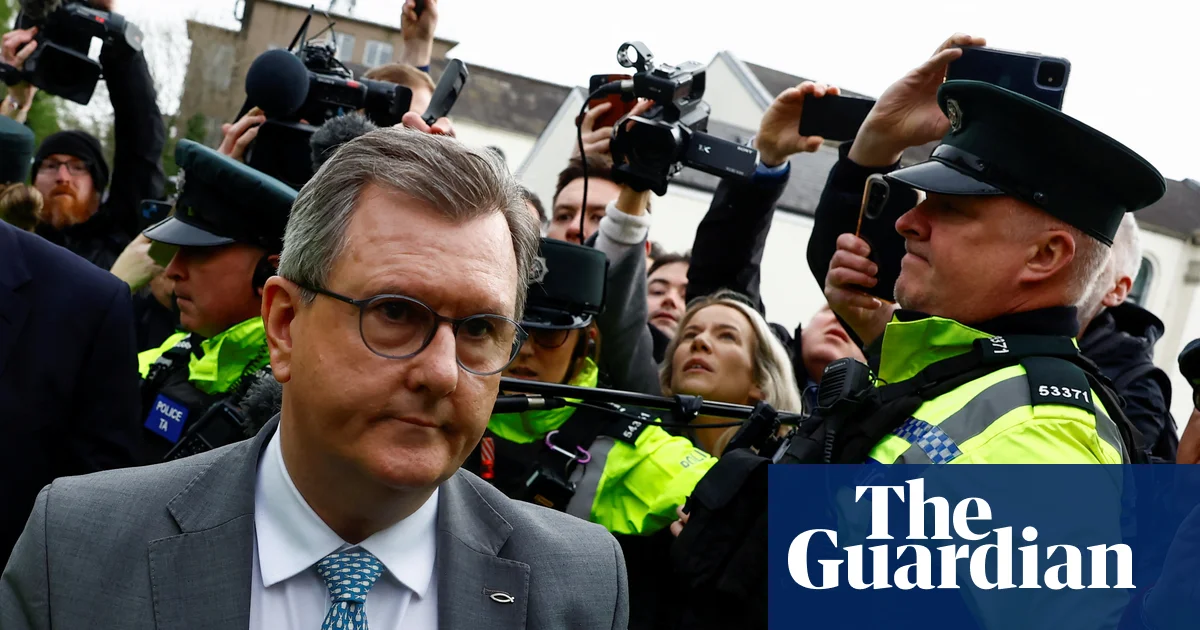
Two years later, the figure who stood convicted in the dock of courtroom one of Newry crown court appeared unchanged – immaculate suit, a bit jowly, no visible emotion – but was now a pariah.
Four weeks of evidence in the often sweltering chamber uncloaked a previously hidden Donaldson, 63, a predator who abused two girls over two decades while ascending the political ranks to prestige and power.
“It is just incomprehensible, that you have known someone for a lifetime and worked with for a lifetime and this happens,” said Reginald Empey, a unionist grandee who used to work closely with Donaldson. “You’re talking stuff which is off the charts here.”
Lord Empey said he got on well with Donaldson when he was a rising star in the Ulster Unionist party (UUP), before his defection to the DUP. “He was very highly regarded, ticked all the boxes, young, articulate, had a nice way with him. He wasn’t aggressive. He wasn’t a shouter.”
Regardless of the verdict, Donaldson was destroyed as a politician, said Empey. “Nobody can put Humpty Dumpty together again.”
The victims, complainant A and B, told the court that behind the media-savvy sheen – Donaldson projected reasonableness even when adopting hardline positions – lurked a manipulative man who abused them from 1985 to 2008.
Complainant A said she was of primary school age when Donaldson began to be “physical” with her and grope her chest. He used a light to look at her genitals and on another occasion kissed her and put his tongue in her mouth, she said. She recalled having nightmares about “men doing horrible things to children”.
Complainant B said the rape happened while she was of primary school age. “I remember being really still and all I could hear was his breath.” The memory of the assault endures, she told the court. “What happened that night will live with me for ever.”
Complainant B said she was of secondary school age during another incident – he lifted up her top and fondled her breasts – which she said was partly witnessed by his wife before she walked away.
She told police in her interview he “had this terrible breath” and was making a “panting sound”. “He never said anything, just always silence.”
Eleanor Donaldson told police, in an interview played in court, that it was a “massive shock” to see the pair alone in a room but that she had no evidence of wrongdoing. “I didn’t go in, I wasn’t in that room, I just stood in the open doorway.”
The trial judge, Paul Ramsey, judged the 60-year-old unfit to stand trial on mental health grounds so she faced a trial of facts, which tests the evidence but cannot result in a criminal conviction.
Donaldson was born into a middle class family in the shadow of the Mourne mountains in County Down, the oldest of five boys and three girls. The Troubles visited tragedy on the family – two cousins, who served in the security forces, were murdered in IRA attacks.
Donaldson won respect and authority in the UUP and later the DUP for his dogged persistence and tactical nous but he was an aloof figure with few close friendships.
There was almost something “smug” about Donaldson, one former colleague recalled. “He is very manipulative, very controlling and gives off an air that believes he is on a mission from God, someone with a direct instruction from above.” The former colleague could barely bring himself to discuss the abuse. “It disgusts me.”
In the 1990s Donaldson apologised to Complainant B during a meeting at a County Antrim Christian centre and in 2020 wrote a letter to Complainant A expressing regret for causing “hurt, pain and distress” and asking forgiveness for a “sinful nature”.
Under cross-examination Donaldson brazened it out and said those apologies referenced not abuse but unrelated matters and accused his accusers of making up the allegations. His barrister, Kieran Vaughan, questioned the complainants’ credibility and honesty. “We say the evidence shows that nothing happened.”
The jury of five women and seven women decided otherwise. Which means that from 1985, when Donaldson was first elected to a Northern Ireland assembly, the non-smoking, non-drinking, church-going politician began a dual life of secretly inflicting harm on innocents while giving polished public performances as a defender of conservative unionism.
Complainant A said that in her 20s she realised the abuse was not normal and became angry, an anger fuelled by the fact she had spent her life watching him in a public role “getting accolade after accolade”. For years she said nothing until eventually confiding in her husband.
“She was worried if she told me it would change my perspective on her,” the husband, who cannot be named to protect her anonymity, told the court. “She was scared. She told me she had never told anyone this. This was trauma she had for so many years, had boxed off, had tried to put on a smile and pretend that everything was OK.”
Donaldson’s prominence and clout intimidated them, said the husband. “We were both terrified.” The trial heard that Complainant B also kept her “memories locked away inside” and blamed herself for not speaking out in time to protect Complainant A.
Both women reached turning points in their lives which prompted them, in March 2024, to give statements about the Donaldsons to police. “Two voices are better than one,” said the prosecutor, Rosemary Walsh.
Donaldson’s reputation – garlanded with a knighthood – was at its zenith. His deal with Rishi Sunak’s Conservative government had ended a two-year DUP boycott of power-sharing over Northern Ireland’s post-Brexit status. Amid ceremonial pomp beneath Stormont’s ornate ceiling, Donaldson watched the assembly revive, and with it hope of political normality.
Instead, before dawn on 28 March, he and his wife awoke to the sound of police at their door. The couple were questioned at the serious crime suite at Antrim police station, charged and released on bail.
The case flabbergasted Northern Ireland. The DUP suspended Donaldson – who in any case resigned – and erased his name and image from the party’s website. In the July 2024 general election Donaldson did not contest his Lagan Valley seat, which he had held since 1997, and vanished from view.
The pre-trial hearings wrenched him back before the cameras. His wife, separated from him by a court security officer, looked the picture of defeat, gaunt and pale, staring up to the ceiling on occasion while Donaldson sat poker-faced, often arms folded, facing proceedings with the same grim determination he had brought to political battles.
The trial laid bare the history of abuse as well as a troubled marriage: it emerged that Donaldson had an affair with a woman in 2008 and that in 2020 his wife, suspecting another affair, had a listening device planted in his car. Eleanor told police that friends had advised her to “get off the Titanic before it sank”.
Donaldson’s wife was not present during the trial, leaving the former DUP leader a solitary figure in the dock. Flanked by custody officers, he remained impassive throughout.
In her summation, the prosecutor exhorted the jury to deliver justice to two victims whose pain and hurt remained visible. “The sexual abuse they suffered has consequences – consequences that cannot be ignored and brushed under the carpet any longer.”
About the Author