
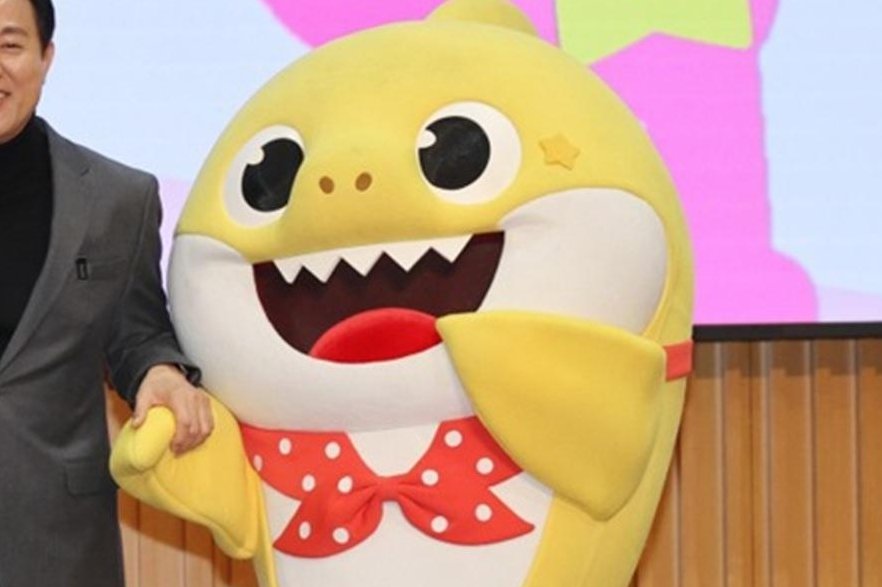
Children’s entertainment characters Baby Shark at Seoul City Hall in Seoul. Photo by YONHAP /EPA
June 16 (Asia Today) — Bebefinn, a fast-growing children’s franchise from South Korea’s The Pinkfong Company, is gaining global popularity and raising expectations that it could become the company’s next major source of revenue after Baby Shark.
The franchise initially built its audience through YouTube and streaming platforms. The company is now seeking to expand it into mobile applications, feature films, live entertainment and licensed products.
Bebefinn was launched in 2022 using the content production expertise and international distribution network The Pinkfong Company developed through Pinkfong and Baby Shark.
The three-dimensional animated series follows a family of five: 20-month-old Finn, his 3-year-old brother Brody, his 4-year-old sister Bora and their parents. Unlike Pinkfong and Baby Shark, which primarily feature animal characters, Bebefinn centers on a human family and targets children ages 1 to 5 as well as their parents.
Bebefinn made its debut through an English-language YouTube channel in April 2022. The company began offering the series through video-on-demand services on streaming and internet television platforms two months later.
The series debuted on Netflix in December 2022 and ranked highly in several major markets. “Bebefinn Season 2” followed in 2023, while the spinoff “Bebefinn Playtime” reached No. 1 in the United States, demonstrating the franchise’s growth potential.
As of the end of the first quarter, Bebefinn had recorded 57.3 billion cumulative YouTube views and 79.26 million subscribers across its channels.
The company has also launched franchise-based mobile services, including the “Bebefinn Baby Care” app, expanding the brand beyond passive viewing into interactive content.
Bebefinn has also shown potential in movie theaters.
The Pinkfong Company released “Bebefinn: The Movie – Lost Bebefinn and the Pinkfong Adventure” during the second half of last year. The film attracted 230,000 moviegoers, the strongest theatrical performance among the company’s films to date.
The result was considered significant for an animated film aimed primarily at preschool-age children.
Bebefinn’s growth could help diversify The Pinkfong Company’s intellectual property portfolio. The company’s international recognition and revenue have historically depended heavily on Pinkfong and Baby Shark.
The rapid expansion of Bebefinn, however, suggests the company may be able to develop another independently profitable global franchise.
Its popularity could generate revenue not only from digital advertising but also from apps, live performances, exhibitions, movies, toys, books and other licensed products. Industry observers say the franchise could eventually produce more than 90 billion won, or about $58.7 million, in annual business performance.
“Bebefinn has grown explosively, and more than 40% of our overall content now centers on the Bebefinn franchise,” Min-seok Kim, CEO of The Pinkfong Company, said at a news conference in November.
Kim said the increased share did not result from a decline in the company’s existing franchises but from Bebefinn’s rapid growth.
He projected that Bebefinn could account for more than half of the company’s content this year if its growth continues.
Such a shift would mark The Pinkfong Company’s transition from relying primarily on Baby Shark to operating a broader portfolio of major global children’s franchises.
— Reported by Asia Today; translated by UPI
© Asia Today. Unauthorized reproduction or redistribution prohibited.
About the Author