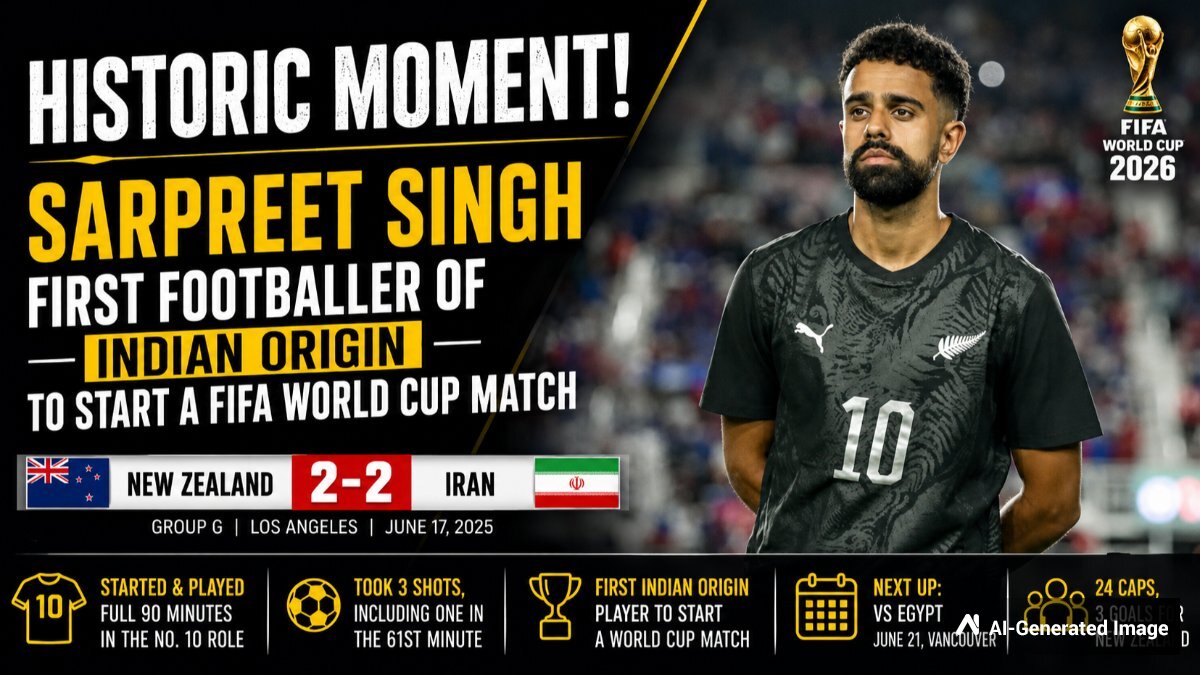
Los Angeles, June 17: New Zealand midfielder Sarpreet Singh etched his name into football history after becoming the first player of Indian origin to start a FIFA World Cup match. The 27-year-old featured in New Zealand’s Group G clash against Iran at the FIFA World Cup, marking a significant milestone for footballers with Indian heritage on the sport’s biggest stage.
The match, played in Los Angeles, ended in an entertaining 2-2 draw as Iran twice came from behind to deny New Zealand a famous victory. Singh, deployed in a central attacking role wearing the iconic No. 10 jersey, started the contest and remained on the pitch until the 90th minute.
Born in Auckland to Punjabi parents, Singh’s World Cup debut carried added significance. New Zealand head coach Darren Bazeley showed his faith in the midfielder by naming him in the starting XI for one of the team’s most important matches in recent years.
Operating as the creative hub in New Zealand’s 4-2-3-1 formation, Singh was heavily involved in attacking moves and registered three attempts on goal. One of his most notable efforts came in the 61st minute as New Zealand pushed for a winner before Iran fought back to secure a point.
A Landmark Moment for Indian-Origin Footballers
Before Singh’s historic start, only one player of Indian descent had appeared in a FIFA World Cup. Former France midfielder Vikash Dhorasoo, whose family roots trace back to Andhra Pradesh, featured briefly during France’s 2006 World Cup campaign in Germany.
However, Dhorasoo came off the bench in both of his appearances, playing only a handful of minutes. Singh’s inclusion in the starting lineup therefore represents a first for footballers of Indian heritage at the World Cup.
The achievement highlights the growing influence of players with Indian roots across global football, even though India itself is yet to qualify for the tournament.
Journey from Auckland to the World Stage
Singh’s rise has been anything but ordinary. The midfielder first gained attention during New Zealand’s participation in the 2018 Intercontinental Cup in Mumbai. Although New Zealand sent a development squad, Singh impressed by scoring against Kenya and providing two assists in a memorable victory over India, led by Sunil Chhetri.
His performances soon attracted European interest. In 2019, Singh became the first player of Indian descent to play in Germany’s Bundesliga after securing a move from Wellington Phoenix to Bayern Munich.
Initially featuring for Bayern Munich’s reserve team, Singh’s progress earned him opportunities under then-head coach Hansi Flick. He later made a senior start for the German giants and was part of Bayern’s Bundesliga title-winning squad during the 2019-20 season.
Subsequent spells in Portugal and Serbia followed before Singh returned to New Zealand on loan this year. Despite suffering an injury setback in February that sidelined him for nearly two months, he recovered in time to earn selection in New Zealand’s 26-man World Cup squad.
More Indian-Origin Talent Emerging
Singh is not the only player with Indian roots featuring at the FIFA World Cup. Australia’s Nishan Velupillay recently made his World Cup debut after coming off the bench in Australia’s victory over Turkiye.
Meanwhile, Qatar’s Tahsin Mohammed Jamshid and DR Congo midfielder Samuel Moutoussamy are also part of World Cup squads, underlining the growing presence of Indian-origin footballers across international football.
Eyes on Egypt Clash
Following the draw against Iran, New Zealand will now turn their attention to a crucial Group G encounter against Egypt on June 21 in Vancouver. With both teams still searching for their first victory of the tournament, Singh is expected to play a key role once again.
For now, however, the Auckland-born midfielder has already secured his place in football history. By stepping onto the field from the first whistle, Sarpreet Singh became a trailblazer for Indian-origin footballers worldwide and a symbol of how far talent can travel across borders and generations.
Story first published: Tuesday, June 16, 2026, 14:03 [IST]
About the Author