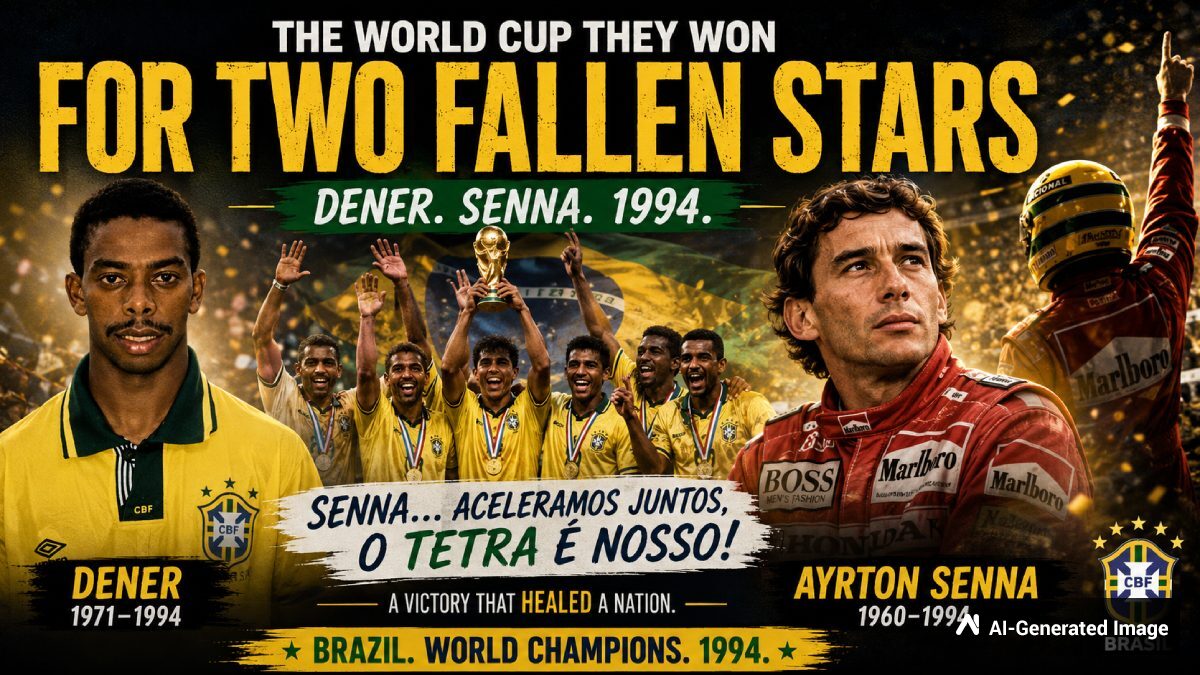
The FIFA World Cup has produced countless unforgettable stories, but only a few have transcended sport to become part of a nation’s collective memory. Brazil’s triumph at the 1994 FIFA World Cup belongs firmly in that category.
Long before Romário, Dunga and Bebeto lifted the trophy in Pasadena, Brazil was a country struggling to cope with unimaginable loss. The spring of 1994 began not with celebrations, but with funerals.
Brazil lost two legends before FIFA WC 1994
The first blow came on April 18. Dener Augusto de Sousa, a 23-year-old footballing prodigy widely regarded as the future of Brazilian football, was killed in a car accident in Rio de Janeiro. Blessed with extraordinary skill and flair, Dener represented everything Brazilians loved about the game. His death robbed the country of a talent many believed would one day stand among its greatest players.
Before the nation could recover from that shock, an even greater tragedy followed.
On May 1, Ayrton Senna, Brazil’s most beloved sporting hero and a three-time Formula One World Champion, lost his life during the San Marino Grand Prix at Imola. For millions of Brazilians, Senna was far more than a racing driver. He was a symbol of excellence, resilience and national pride. The yellow helmet that had inspired a generation would never be seen crossing a finish line again.
In the span of just thirteen days, Brazil lost two of its brightest stars. One represented the future. The other embodied the present.
The grief was overwhelming. Yet four months later, a football team carrying the hopes, pain and memories of an entire nation would travel to the United States and achieve something far greater than winning a World Cup.
They would help Brazil smile again. Brazil didn’t just lose two athletes. It lost permission to smile.
In a nation where sport transcends entertainment to become the heartbeat of national identity, these weren’t mere deaths. They were amputations. Millions lined the streets of São Paulo for Senna’s funeral. The government declared three days of official mourning. Bars closed. Traffic stopped. The country had been violently stripped of its brightest stars in the span of weeks.
Yet somewhere in that darkness, a football team was preparing for the United States.
The Inheritance: Senna’s Final Promise
Ten days before his death, Ayrton Senna crossed paths with the Brazilian national team. Prior to a friendly match against Paris Saint-Germain on April 20, Senna was invited to kick off the match. He went into the locker room – no handlers, no ceremony – and spoke to the players with the intensity that had defined his entire career.
“This is our year,” he told them. “You will win the fourth World Cup, and I will win the fourth championship.”
Words spoken with the confidence of a man who had stared death in the eye at 300 kilometres per hour and walked away. Words that felt like predictions from someone who understood what was possible.
Ten days later, those words transformed from prophecy into vow.
When Senna died, the Brazilian squad wasn’t mourning a celebrity. They were carrying an inheritance. They had a promise to keep-not just to themselves, not just to the nation, but to a man who had believed in them when their own country was collapsing under grief.
Building a Different Brazil
The squad that traveled to the United States in the summer of 1994 was unfamiliar to fans accustomed to the flair-filled, improvisation-based teams of the 1980s. This wasn’t a team of showmen. This was a team built by Carlos Alberto Parreira with deliberate pragmatism.
Captain Dunga – gritty, defensively sound, a warrior’s heart in a midfielder’s body. Romário and Bebeto – the lethal attacking duo who had set aside personal differences for something larger. Goalkeeper Cláudio Taffarel, barely into his twenties but carrying the weight of a nation on his shoulders.
They weren’t the most talented Brazil had ever fielded. They were, perhaps, the most unified. Every player understood why they were there. The flair could wait. This World Cup was about catharsis.
Throughout the grueling American heat, the spirit of Senna lingered. In the 120th minute of a scoreless final, with Italy across from them and the pressure at its absolute peak, the players weren’t thinking about technique. They were thinking about the promise. About a yellow helmet. About a 23-year-old talent who would never play professionally again.
The Moment Everything Changed
July 17, 1994. The Rose Bowl in Pasadena. Brazil versus Italy in the most exhausting, tension-filled World Cup final ever played.
One hundred and twenty minutes. No goals. The match had been a stalemate-Italy’s catenaccio defending perfectly, Brazil unable to break through. Both teams had empty tanks. Both teams had empty hope.
Then came the penalty shootout.
Roberto Baggio, the Italian maestro, stepped up to take what would be the decisive penalty. In that moment, he represented everything that had haunted Brazil all tournament-the weight of expectation, the crushing burden of a nation’s hope, the knife-edge between glory and devastation.
Baggio struck the ball. It sailed over the crossbar.
Cláudio Taffarel dropped to his knees, arms raised to the heavens. Brazil were champions of the world for a record fourth time. Tetracampeão.
In the immediate aftermath of victory, amid the confetti and tears, the Brazilian players did something that transcended sport. They unfurled a massive banner on the pitch-a message to the hero they had lost just months prior.
It read: “Senna… aceleramos juntos, o tetra é nosso!” (Senna… we accelerate together, the fourth is ours!)
What the Trophy Really Meant
The FIFA World Cup is a trophy. The 1994 victory was much more. It was national healing. It was permission for a grieving country to smile again. It was proof that while Brazil had lost Dener’s unbounded potential and Senna’s relentless drive, the resilient, beating heart of the nation remained unbroken.
Romário, Dunga, Taffarel, and the rest of that squad didn’t just win a football match. They delivered their country from despair. They proved that out of profound sorrow could emerge unexpected triumph. That collective grief could be transmuted into collective purpose.
For Dener – the joyful, improvisational street footballer whose magic could never be replicated – and for Senna – the global conqueror whose yellow helmet would never streak across another finish line – Brazil finally had its answer to the only question that mattered: Did we make them proud?
The banner said it all.
About the Author