
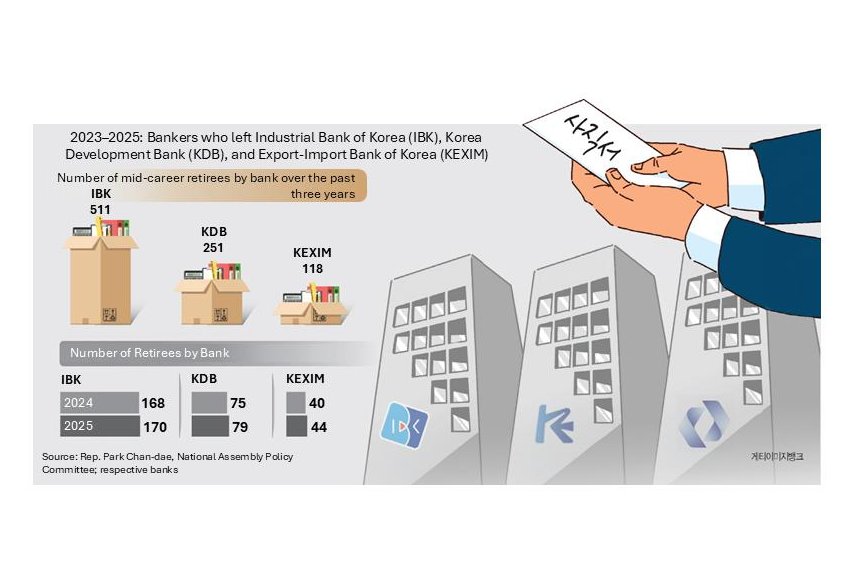
A graphic shows the number of mid-career employees who left South Korea’s three major policy banks — the Industrial Bank of Korea, the Korea Development Bank and the Export-Import Bank of Korea — between 2023 and 2025. A total of 880 employees departed during the period, including 511 from the Industrial Bank of Korea, 251 from the Korea Development Bank and 118 from the Export-Import Bank of Korea. Graphic by Asia Today and translated by UPI
March 11 (Asia Today) — Nearly 900 employees have left South Korea’s major state-run policy banks over the past three years, raising concerns about growing talent outflows linked to lower pay and potential relocation outside Seoul.
Data submitted to the National Assembly by the Industrial Bank of Korea, Korea Development Bank and Export-Import Bank of Korea show that 880 employees resigned before retirement between 2023 and 2025.
The Industrial Bank of Korea saw the largest number of departures with 511 employees leaving during the period, followed by the Korea Development Bank with 251 and the Export-Import Bank of Korea with 118.
While the number is smaller than departures at major commercial banks, analysts say the trend is more concerning because policy banks rarely offer voluntary retirement programs with large severance packages.
Commercial banks often encourage early retirement through compensation worth hundreds of millions of won. In contrast, policy banks generally retain older employees under wage peak systems that gradually reduce pay before retirement.
Industry officials say the departures at policy banks are therefore more likely to involve mid-career professionals rather than older workers.
Salary differences appear to be a key factor. Employees at policy banks earn an average annual salary of about 100 million won ($75,000), compared with roughly 120 million won ($90,000) at the country’s four largest commercial banks.
When performance bonuses and other benefits are included, the pay gap can widen further, according to banking officials.
“In the past, the salary gap with commercial banks was less than 10 percent, but recently it has widened to as much as 30 percent,” one policy bank official said. “Quite a few employees leave because of the difference in pay.”
Another source of concern among employees is the possibility that policy banks could be relocated outside Seoul under the government’s regional development policy.
The government plans to review public institutions this year to determine which organizations could be moved to other cities.
A previous proposal to relocate the Korea Development Bank to the southern port city of Busan during the administration of former President Yoon Suk-yeol triggered a noticeable rise in employee departures in 2023.
Financial industry officials say younger staff members were particularly affected by the possibility of relocation.
“When the Busan relocation plan was being discussed, many younger employees left the bank,” one financial sector official said. “Losing mid-career professionals also weakened institutional expertise.”
Some analysts warn that if policy banks are again included in relocation plans, resignations could increase further.
A policy bank official said concerns are growing among younger employees.
“Many younger staff members are talking about moving to commercial banks,” the official said. “Salaries are already lower, and the possibility of relocation outside Seoul is making employees uneasy.”
— Reported by Asia Today; translated by UPI
© Asia Today. Unauthorized reproduction or redistribution prohibited.
About the Author