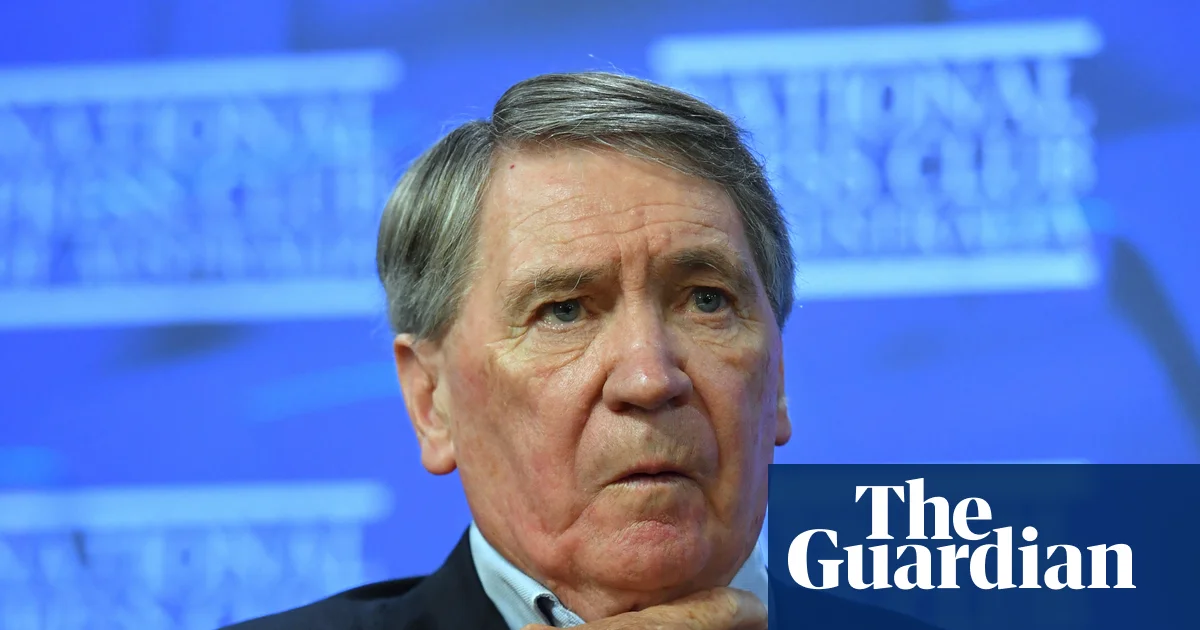
Former spy chief Dennis Richardson said he resigned from the antisemitism royal commission because he felt “surplus to requirements”, claiming changes to the inquiry into the Bondi terror attack were different to the job he signed up for, and that he was being “way overpaid”.
Richardson said the royal commission, led by judge and lawyer Virginia Bell, would still be valuable and praised Bell strongly. But in his first comments since Wednesday’s surprise announcement that he had abruptly departed the inquiry, Richardson appeared to hint that he had been left without much work to do – despite being tasked to deliver an interim report by the end of next month.
“There wasn’t enough discussion right at the beginning about the precise way things would work. And ultimately, I came to it that I was surplus to requirements,” he told the ABC’s Radio National on Thursday.
Sign up: AU Breaking News email
In a separate interview on ABC Sydney radio, Richardson added: “When you stripped everything down, I was essentially being employed as a research officer and to lead a team of researchers.”
He said his decision was “not anything to do with the government… the government isn’t responsible in any way.”
Richardson – who has previously served as director-general of the Australian Security Intelligence Organisation, Australia’s ambassador to America and secretary of the Department of Foreign Affairs and Trade – had initially been named to lead an inquiry into intelligence and policing failures which contributed to the terror massacre at a Bondi Hanukah festival last December, where 15 people were shot dead.
Later, after the government relented to calls for a royal commission into the attack and the broader issues of antisemitism in Australia, Richardson’s review was folded into Bell’s broader inquiry, and he was named as a special adviser to the inquiry. Questions were raised at the time, and since, about how the two processes would interact and if Richardson would be able to probe sensitive intelligence matters in the scope of a royal commission holding public hearings.
Late on Wednesday, the royal commission announced that Richardson had resigned from the inquiry, thanking him from his service but providing no explanation for his decision. It came a fortnight after its opening hearing, and six weeks before Richardson was scheduled to lodge an interim report (by 30 April).
Bell said in a statement that work on the interim report was “well advanced”, and that she was confident it would be delivered on time. Sheexpressed “gratitude” for Richardson’s work.
“As I noted at the Commission’s initial hearing, Mr Richardson was uniquely well placed to advise on the material to be sought from our intelligence and security agencies in order to assess the effectiveness of their preparedness for, and response to, a terrorist attack.”
Bell said two other senior staff who worked with Richardson – Tony Sheehan, the former Commonwealth counterterrorism coordinator and Asio deputy director general, and Peter Baxter, a former deputy secretary at the Department of Defence – remained with the commission, and were working on the interim report.
Asked why he felt “surplus to requirements”, Richardson told the ABC his job had emerged as different to the one he was initially asked to do. He added that “what I was being paid wasn’t consistent with the work I was doing”, and in subsequent interviews on Thursday claimed: “I was being way overpaid for what I was doing”.
“I wasn’t doing an interim report independent of the royal commission. The report which I had been doing, prior to the royal commission being formed, was folded into the royal commission. And soon as it became folded into [it], particular legal frameworks were put around it,” he told Radio National.
“So the interim report that will now be done by the royal commission … will be a very different document to the one that I would have done when I was doing the review, prior to the royal commission being announced.”
Richardson said the report “will still be a valuable document” and expressed confidence that the royal commission would “do a highly professional job”.
The royal commission was contacted for comment.
The attorney general, Michelle Rowland, thanked Richardson for his work, and said the government expected the interim report to be delivered on time.
“The royal commission, which is independent of government, will provide further updates in due course,” she said.
The royal commission’s final report is due by 14 December.
About the Author