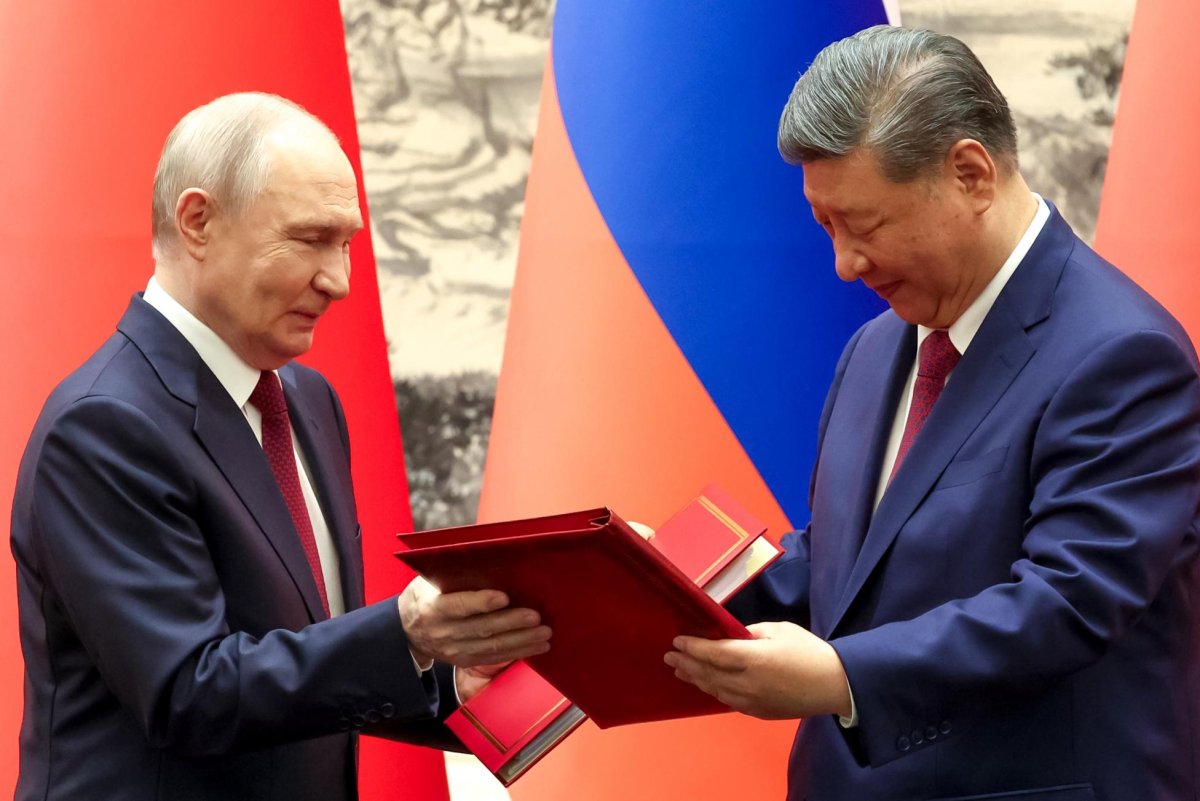
Despite a raft of unrelated agreements resulting from talks between President Vladimir Putin (L) and Chinese President Xi Jinping on Wednesday, the pair failed to make progress on a long-planned 1,615 mile second pipeline from Siberia to supply China with natural gas. Photo by Alexander Kazakov/EPA
May 20 (UPI) — Talks between Russian President Vladimir Putin and Chinese President Xi Jinping on Wednesday failed to make progress on a long-planned 1,615-mile pipeline to supply China with an annual 50 billion cubic meters of natural gas from Russia’s Yamal field in Siberia.
The Power of Siberia 2 project negotiations on the final day of Putin’s two-day state visit to Beijing stalled due to differences over the timetable, financing and cost of the gas with Beijing holding out for a price of around 12-13 cents per cubic meter, in line with the cost in the domestic Russian market.
Moscow and Beijing signed a binding contract to develop the project during Putin’s last visit to China in September but left the details to be ironed out down the line.
Russia wants a similar deal to that for Power of Siberia 1, which experts projected would mean the price of the gas would be at least double the 12-13 cents figure.
The talks yielded 20 other trade and technology agreements and while a joint leaders’ statement talked of boosting their “comprehensive partnership” and shared vision “for a multipolar world and a new type of international relations,” the summit produced no breakthroughs of any great significance.
Analysts said the power imbalance in the Sino-Russia relationship — one where Russia needed China more than China needed Russia — was on full display during Putin’s visit.
Putin said that as one of China’s largest energy suppliers, Russia was ready to “reliably” meet fast-growing Chinese demand for oil, gas and coal.
“Russia and China are actively cooperating in the energy sector. Our country is one of the largest exporters of oil, natural gas, including liquefied gas, and coal to China. We are, of course, ready to continue to reliably ensure uninterrupted supplies of all these fuels to the rapidly growing Chinese market,” Putin said in comments that made no reference to the pipeline.
Kremlin spokesman Dmitry Peskov said the sides had “reached an understanding on the project’s main parameters” in Wednesday’s talks but that “some nuances remain to be ironed out.”
Beijing, which is looking to Russia to ameliorate the energy shock from the severe disruption to its supplies of oil and LNG caused by the Iran war and the closure of the Hormuz Strait, has already imported 35% more Russian oil in the January to March quarter than in the same period in 2025.
“Both China and Russia need each other, but Russia clearly needs China more than before at the global stage. Given today’s international environment, deep co-operation with China is extremely important for Russia in dealing with many of its current challenges,” Zheng Runyu, of the Centre for Russian Studies in Shanghai, told the BBC.
About the Author