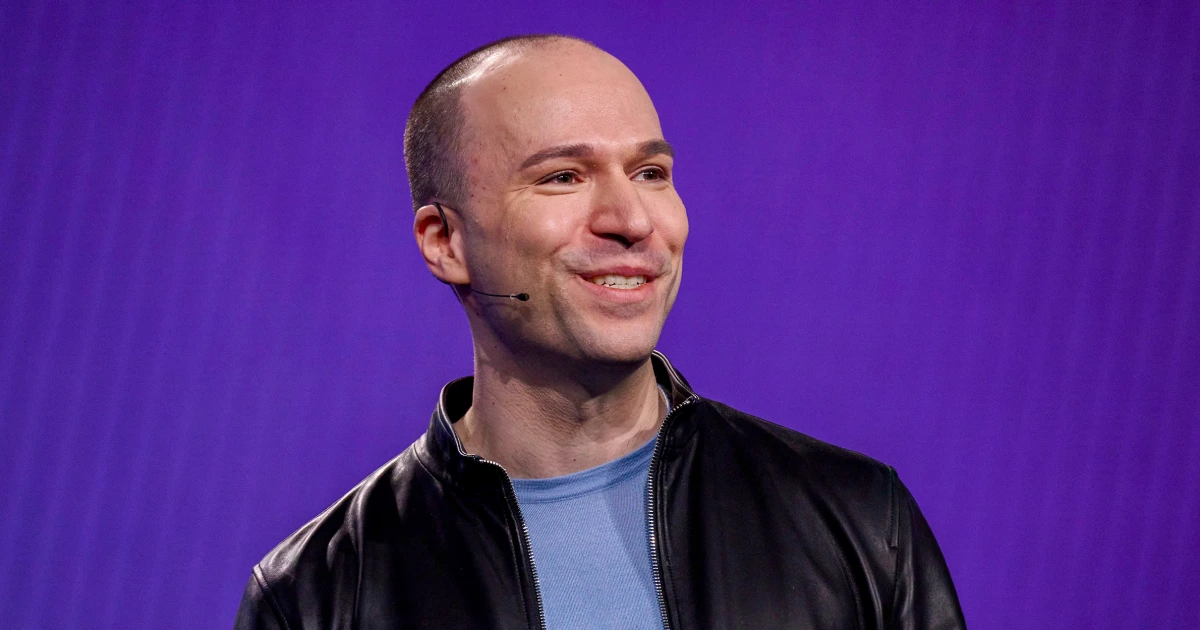
OAKLAND, Calif. — OpenAI co-founder and president Greg Brockman disclosed in a trial Monday that his stake in the firm is worth nearly $30 billion, confirming a figure that co-founder Elon Musk has pointed to in arguing that OpenAI has abandoned its mission as a nonprofit organization.
Subscribe to read this story ad-free
Get unlimited access to ad-free articles and exclusive content.

Brockman took the stand during the fourth day of the trial. Musk is suing Brockman and OpenAI CEO Sam Altman, alleging that they unlawfully converted a charity that he helped start into a for-profit business, best known for creating the popular artificial intelligence app ChatGPT.
Brockman was repeatedly asked to reconcile his nearly $30 billion stake with OpenAI’s stated mission of making AI technology to benefit all of humanity. He testified that the mission hasn’t changed, even after its board has sold equity stakes to outside investors.
“You just happen to be $30 billion richer?” asked Musk lawyer Steven Molo.
“Compensation was certainly secondary to the mission,” Brockman responded.
The trial could reshape OpenAI as an organization and alter the industry-wide push for advanced AI. It’s also unusual for featuring testimony from rival tech billionaires.
Musk, the CEO of Tesla, SpaceX and xAI, vowed to make Brockman and Altman “the most hated men in America” through evidence presented at the trial, according to the content of text messages included in a court filing Sunday. Musk texted Brockman two days before the trial began to gauge the possibility of a settlement, according to the filing by OpenAI’s lawyers.
Monday’s testimony was combative, raising ideas about what kind of tech industry wealth is truly deserved. Molo at one point compared Brockman to a “guy who robs a bank,” a phrase that was stricken as argumentative by U.S. District Judge Yvonne Gonzalez Rogers. At another point, Molo asked Brockman about transferring assets from OpenAI’s charitable side to its for-profit side to create a “money-making machine.”
Brockman pushed back. He testified that he was given his stake in OpenAI in 2018, years before the release of ChatGPT when it was far from certain that the organization would be successful either financially or technologically. He said OpenAI’s board granted him the stake, and that he didn’t participate in the board vote to do so.
He testified that OpenAI is still controlled by a nonprofit foundation, and that its for-profit arm is what’s known as a public-benefit corporation, a type of corporation that must take into account both a public-spirited mission as well as the interests of shareholders. He said that all of OpenAI’s co-founders, Musk included, wanted it to have a for-profit arm of some kind and that what they disagreed on was the details.
And he said that Musk has little connection to OpenAI as it exists now. Musk stopped donating to OpenAI in 2017 and left its board in 2018.
“That is something that we’ve built through blood, sweat and tears, during all these years since Elon left,” Brockman testified.
The first OpenAI office was Brockman’s apartment in San Francisco, he testified.
Brockman is relatively obscure compared to the trial’s other billionaires, Musk and Altman, but is a well-known figure within the tech industry. Before co-founding OpenAI in 2015, he was the chief technology officer of payments company Stripe.
But his passion for the subjects at issue came through. Brockman at times spoke so quickly that the court reporter making a transcript could not keep up, and the judge stepped in to urge Brockman to speak more slowly. Several times, Brockman had to repeat himself to make the record clear.
OpenAI said in March that it was valued at $852 billion after its latest funding round. After a restructuring in October, the nonprofit foundation arm owned 26% while OpenAI employees owned 26%.
Molo, though, kept turning the testimony back to the nearly $30 billion figure, which Musk posted about last year on X. Musk’s lawsuit alleges that Brockman, Altman and others breached their duties to OpenAI as a charitable organization and unlawfully enriched themselves.
Molo mentioned the nearly $30 billion figure more than a dozen times during more than two hours of questioning Brockman.
“Do you believe that your nearly $30 billion stake… breaches your duty to humanity?” he asked.
“No, I believe that we have developed the most well-capitalized nonprofit in human history,” Brockman responded.
Molo pressed Brockman on whether his primary motive was actually financial. He quoted from a September 2017 journal entry in which Brockman wrote to himself, while pondering OpenAI’s future, “Financially, what will take me to $1B?”
Brockman testified that the money was always secondary.
Molo asked Brockman whether he would consider limiting his own compensation to $1 billion and giving the balance of his wealth back to the nonprofit arm of OpenAI.
“Do you think, sitting here today, given that you’re good with the $1 billion, do you think you should give the $29 billion back to the charity?” the lawyer asked.
“That’s not how I think about it,” Brockman responded. “There are assumptions baked into the question,” he added, without elaborating.
At another point, Molo asked, “It takes $30 billion to get you out of bed in the morning, but $1 billion doesn’t get you out of bed in the morning?”
Brockman responded, “That’s not what I’m saying.”
Not mentioned during Monday’s testimony was Musk’s net worth, estimated at $657 billion, highest in the world, according to Bloomberg.
About the Author