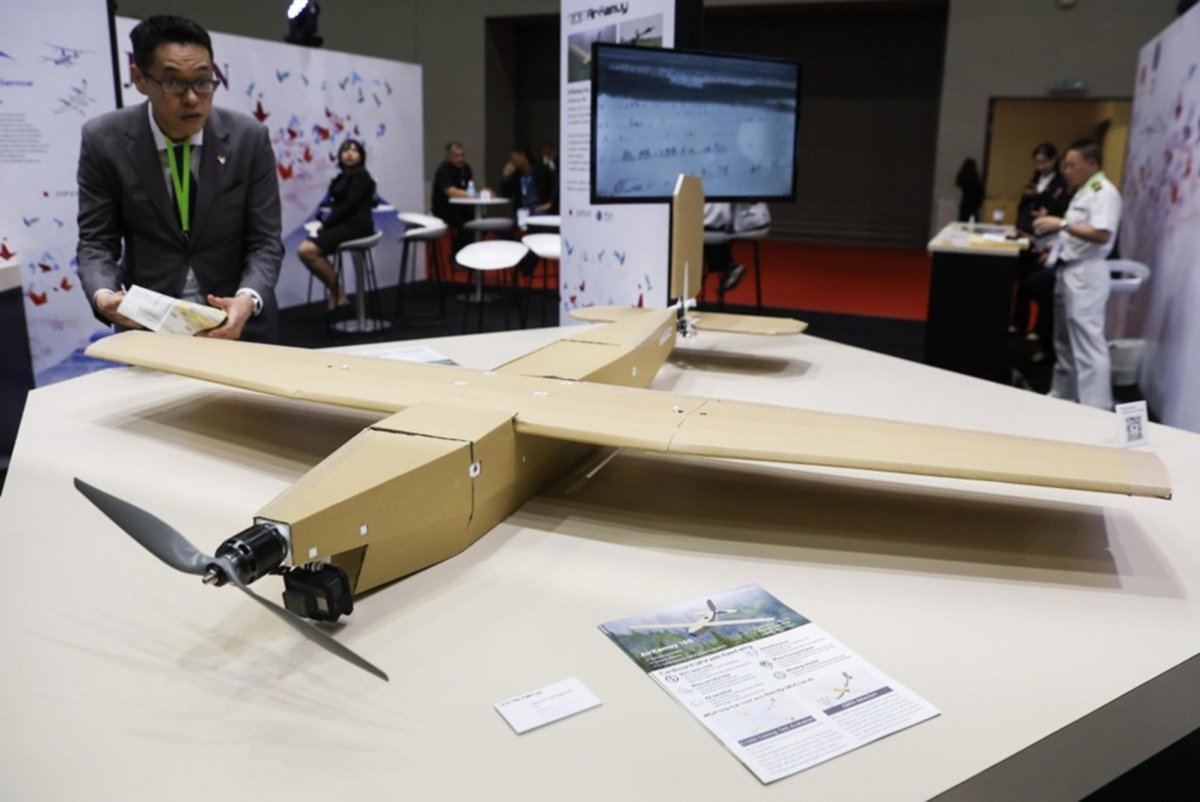
A visitor examines the ‘AirKamuy 150,’ a low-cost fixed-wing drone constructed from cardboard and developed by Japanese startup AirKamuy, at the Defence Services Asia (DSA) and National Security (NATSEC) Asia 2026 exhibition in Kuala Lumpur, Malaysia, 21 April 2026. The defense and security exhibition runs from 20 to 23 April. Photo by FAZRY ISMAIL / EPA
May 3 (Asia Today) — Japan is accelerating deployment of low-cost “cardboard drones,” signaling a shift in modern warfare from technological sophistication to cost efficiency and mass deployment.
The drones, developed by Japanese defense startup AirKamuy and supplied to the defense ministry, are designed with reinforced cardboard structures that reduce radar detection while dramatically lowering production costs.
The model, known as the “AirKamuy 150,” represents what analysts describe as a “low-tech high-tech” approach. Its wings and fuselage are made largely from specially coated reinforced cardboard, engineered to withstand humidity and temperature changes.
Each unit costs about 300,000 yen, or roughly $2,000, making it less than 1% of the price of conventional small military drones used by the U.S. Navy or Japan’s Self-Defense Forces.
The drones are delivered in flat-pack kits and can be assembled in about five minutes without specialized tools, allowing rapid deployment by ordinary soldiers.
Operationally, the drone has a top speed of about 120 kilometers per hour, a range of roughly 150 kilometers and a payload capacity of 1.5 to 2 kilograms, enabling it to carry sensors or explosive devices.
Cost asymmetry as a weapon
The real impact of cardboard drones lies not in their physical destructive power but in their economic effect on enemy defenses.
Because cardboard absorbs or scatters radar waves, the drones have a very low radar cross-section, making early detection by conventional air defense systems difficult.
This allows attackers to force defenders into costly decisions. Air defense systems may expend surface-to-air missiles costing hundreds of thousands to millions of dollars to intercept drones worth only a few thousand dollars.
When deployed in large numbers, the drones can overwhelm air defense systems through swarm tactics, exceeding interception capacity and depleting missile stockpiles.
Japan’s shift toward unmanned warfare
Japanese Defense Minister Shinjiro Koizumi has emphasized expanding unmanned systems since taking office.
Japan’s defense budget for fiscal year 2026 reached about 9 trillion yen, or approximately $60 billion, with significant allocations toward drones and unmanned systems. About 277.3 billion yen, or roughly $1.9 billion, is earmarked for drone deployment and procurement.
A key initiative is the “SHIELD” system, a layered coastal defense network that integrates thousands of small attack drones, unmanned surface vessels and unmanned underwater vehicles to block enemy access.
Japan is also diversifying its defense supply chain by incorporating startups like AirKamuy, reducing reliance on major defense contractors and enabling rapid wartime production, potentially even converting civilian cardboard factories into drone manufacturing facilities.
The Japan Maritime Self-Defense Force is already using the AirKamuy 150 as an aerial target drone to accumulate flight data, which could allow rapid conversion into attack drones through software updates.
Production and deployment bases are being established in strategically sensitive island regions, including the Nansei Islands, where low-cost deterrence is seen as more practical than deploying expensive assets.
A new standard in warfare
Similar cardboard drone systems, such as those developed by Australian company SYPAQ, have already demonstrated effectiveness in the Ukraine war, including attacks on advanced Russian military assets.
Japan appears to be incorporating these lessons into a national-level strategy.
Analysts say the rise of cardboard drones highlights a fundamental shift in warfare: victory may depend less on advanced weapons and more on the ability to sustain large-scale, low-cost deployments.
— Reported by Asia Today; translated by UPI
© Asia Today. Unauthorized reproduction or redistribution prohibited.
About the Author