
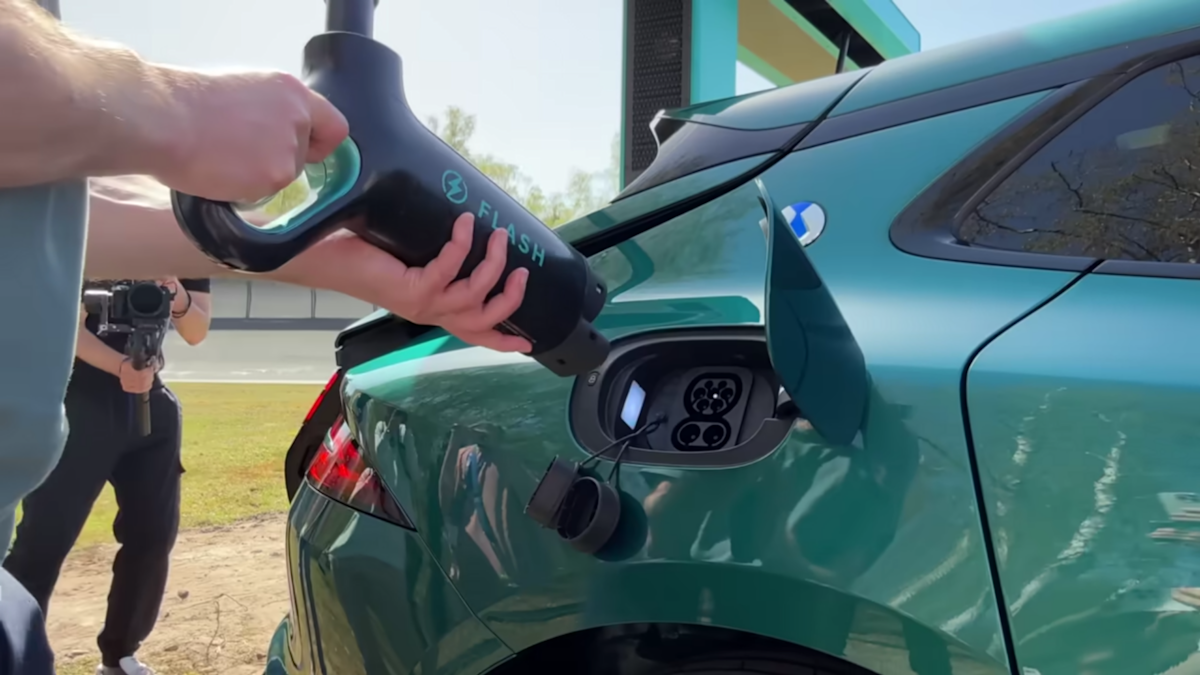
China’s electric vehicle industry may be entering a new phase that’s not defined by range, but by charging speed.
Arguably, the spark for this fire started from BYD and Contemporary Amperex Technology Co. Limited, whose latest battery systems claim to push state of charge from 10 per cent to as high as 97 per cent in under 10 minutes.
That benchmark has now set off an aggressive, industry-wide response reshaping expectations across the sector.
At the Beijing Auto Show, fast-charging technology emerged as the defining battleground. One of the major takeaways from the Beijing event is that battery makers and automakers are no longer speaking in incremental gains.
Instead, they are targeting single-digit charging times, a threshold that brings EV refueling closer to the convenience of internal combustion vehicles.
Second-Tier Suppliers Step Up
Image Credit: Out of Spec Reviews / YouTube.
A wave of second-tier battery suppliers is leading much of this push. CALB Group, EVE Energy, and Sunwoda Electronic each introduced next-generation battery systems capable of charging from 10 per cent to 70 per cent in under 10 minutes.
This metric is critical. It reflects real-world usage patterns where drivers top up rather than fully recharge, and it signals a shift toward ultra-high charging power delivery systems that can sustain extreme current without degrading battery life.
Sunwoda Electronic also demonstrated how this technology can scale beyond passenger vehicles.
The company unveiled an electric bicycle battery that charges from 10 per cent to 80 per cent in 20 minutes while maintaining durability for at least 2,000 charge cycles. That lifecycle figure is significant, as fast charging traditionally accelerates battery wear.
Achieving both speed and longevity suggests meaningful advances in thermal management, cell chemistry, and electrode stability.
Meanwhile, Nio is reinforcing an alternative path to solving charging anxiety. Known for its battery-swapping ecosystem, the company staged a live demonstration showing a full battery swap completed in just three minutes.
While not a charging solution in the conventional sense, the timing undercuts even the fastest charging claims and highlights a parallel strategy in China’s EV infrastructure race.
The Turning Point and Technical Hurdles

Image Credit: Southworks / Shutterstock.
Industry engineers and analysts see this moment as a turning point. According to Sunwoda battery specialist Li Xianyang, the time required to replenish energy remains one of the last areas where EVs lag behind petrol vehicles in China.
Closing that gap is now a priority across the entire supply chain, from cell manufacturers to charging network operators.
The technical challenge is substantial, however.
Charging an EV battery to near full capacity in under 10 minutes requires ultra-high voltage platforms, often exceeding 800 volts, alongside charging systems capable of delivering several hundred kilowatts of power.
It also demands new battery chemistries that can accept high current without lithium plating or excessive heat buildup. Companies are investing heavily in silicon-based anodes, advanced electrolytes, and improved cooling architectures to make these systems viable at scale.
What is unfolding in China is more than a series of product launches. It is a coordinated acceleration across an ecosystem that includes automakers, battery giants, and infrastructure providers.
The speed of iteration and deployment is setting a pace that Western competitors may struggle to match, particularly given differences in charging infrastructure density and regulatory environments.
Global Implications
The implications are profound for the global auto market.
If Chinese manufacturers succeed in standardizing sub-10-minute charging, consumer expectations will shift accordingly.
Range anxiety, long seen as a major barrier to EV adoption, could give way to a new metric centered on charging convenience and time efficiency.
In this environment, charging speed has moved from a secondary specification to becoming a primary selling point, one that could redefine competitiveness in the global EV market.
China’s industry is moving with urgency, and the rest of the world is now under pressure to respond.
If you want more stories like this, follow Guessing Headlights on Yahoo so you don’t miss what’s coming next.
About the Author