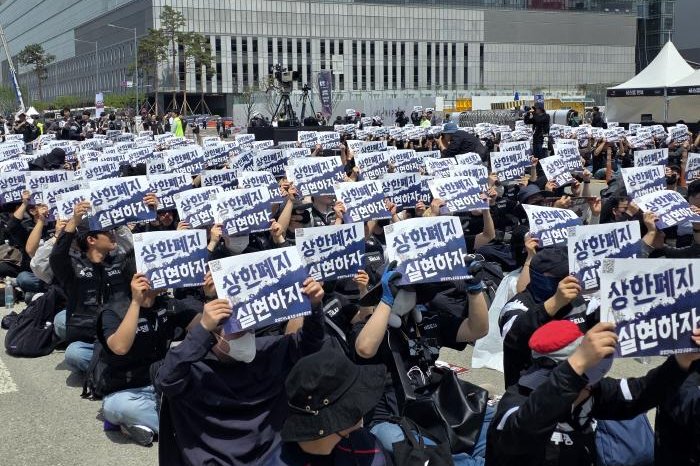
Samsung Electronics union members chant slogans during a rally at the company’s Pyeongtaek campus in Gyeonggi Province on April 23. Photo by Asia Today
April 29 (Asia Today) — This commentary reflects the reporter’s view.
On April 23, when Samsung Electronics union members held a rally in support of a strike, workers wearing protest vests began heading to restaurants near the company’s Pyeongtaek campus as the two-hour gathering ended around 4 p.m.
It was a day when tens of thousands of union members had gathered under a shared cause, and some began celebrating early over drinks. While having a late lunch after covering the event, one remark from a nearby table stood out.
“What are they going to do with only four people crawling out?”
It was an open mockery of Samsung Electronics shareholders who had held a counter-rally the same day.
The labor dispute at Samsung Electronics over performance bonuses is reaching a breaking point. After four months of negotiations since December failed to narrow differences, the union has warned of a full strike as early as next month. Its warning that a shutdown of semiconductor lines could cause tens of trillions of won in damage was enough to provoke shareholders who had been quietly watching the dispute.
Samsung Electronics shareholders launched the Korea Shareholder Movement Headquarters and began counter-rallies largely to prevent damage to corporate value and shareholder rights.
The union is demanding performance bonuses funded by 15% of the company’s operating profit. Given this year’s Samsung Electronics operating profit forecast of 300 trillion won ($203 billion), the demand would amount to 45 trillion won ($30.4 billion). That is more than four times the 11.1 trillion won ($7.5 billion) paid in shareholder dividends last year.
The demand also exceeds last year’s research and development spending of 37.7 trillion won ($25.5 billion), raising concerns about future investment directly tied to corporate value.
It raises the question of what the union means when it says its “sense of ownership” and “loyalty to the company” have been damaged. Internal employees appear more indifferent to the company’s survival than shareholders, who are external stakeholders.
Fair compensation for labor is critically important. But the astronomical bonus demanded by the union cannot take priority if it damages the assets of shareholders, who are the company’s actual owners. Operating profit is not only the result of employees’ labor. It also reflects the patience and time of shareholders who continued to provide capital and believe in the company’s future during difficult times.
This labor dispute leaves a sharp contrast between a union gathered around short-term gains and shareholders gathered around the company’s long-term survival.
There may have been a struggle to secure benefits, but there was no sense of ownership toward the company. By contrast, the shareholders who became the target of ridicule at drinking tables chose to stand as the company’s shield.
At a moment of crisis, it is time to ask who is truly protecting the company.
— Reported by Asia Today; translated by UPI
© Asia Today. Unauthorized reproduction or redistribution prohibited.
About the Author