
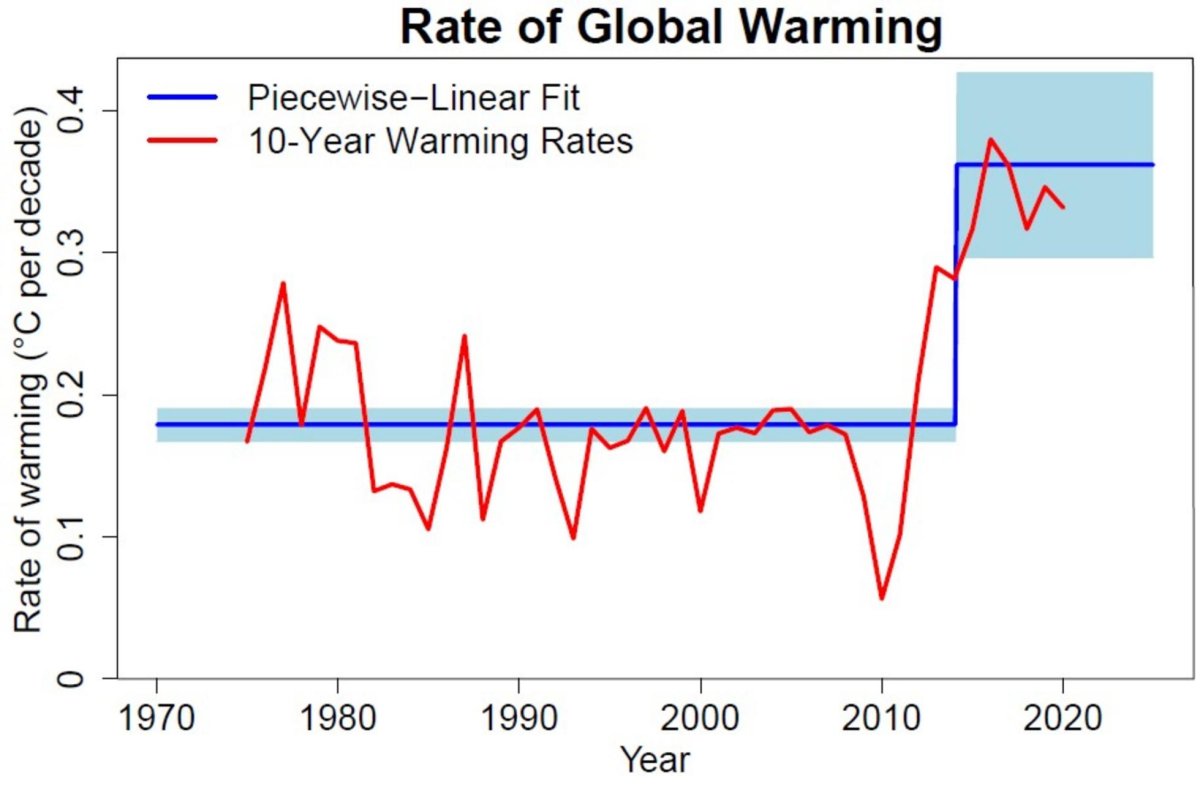
An analysis of global temperatures shows that the rate of warming has increased over the last 10 years. Figure courtesy of Potsdam Institute for Climate Impact Research
March 6 (UPI) — Researchers have detected a “statistically significant” increase in the pace of global warming on Earth for the first time, based on an analysis of data collected over the last decade.
Since 2015, the Earth’s temperature has warmed by roughly .035 degrees Celsius per decade, compared to just under 0.2 degrees Celsius per decade between 1970 and 2015, researchers at Potsdam Institute for Climate Impact Research wrote in a study published in the journal Geophysical Research Letters.
While previous analyses had not reached a 95% confidence level, climate scientists at PIK removed the influence of three natural factors from the data, which they refer to as noise, to determine the portion of warming caused by human consumption.
“The adjusted data show an acceleration of global warming since 2015 with a statistical certainty of over 98%, consistent across all data sets examined and independent of the analysis method chosen,” Stefan Rahmstorf, researcher at PIK and lead author of the study, said in a press release.
PIK researchers analyzed global temperature anomaly datasets from NASA, the National Oceanic and Atmospheric Administration (NOAA), the Hadley Center/Climate Research Unit in the United Kingdom, the Berkeley Earth Surface Temperature project and the European Center for Medium-range Weather Forecasting to determine shifts in temperature since 2015.
First, the researchers estimated and removed the influence of the El Niño natural climate cycle in the Pacific Ocean, volcanic activity on Earth and variation in solar output.
Previous studies have shown human activity has accelerated climate change by a factor 170 times that of natural forces, which researchers have said make previous analyses of temperature fluctuation more difficult to estimate with confidence.
Grant Foster, a U.S. statistics researcher and co-author of the study, said in the release that filtering out natural causes in the data, making it less “noisy,” makes the “underlying long-term warning signal more clearly visible.”
Using data from the five sources, the researchers analyzed data dating to 1880 — the oldest detailed recordings of temperature — finding that the rate of climate change has increased in a “statistically significant” manner, by nearly two-tenths of a point since 2015.
In all five datasets, they found that the accelerating rate of warming becomes “apparent” in 2013 and 2014, though the researchers note that their study does not investigate the specific causes for it.
Rahmstorf warned that at its current pace, Earth’s temperature could exceed the 1.5 degree-limit recommended in the Paris Agreement in less than 5 years.
“How quickly the Earth continues to warm ultimately depends on how rapidly we reduce global [carbon dioxide] emissions from fossil fuels to zero,” he said.
About the Author