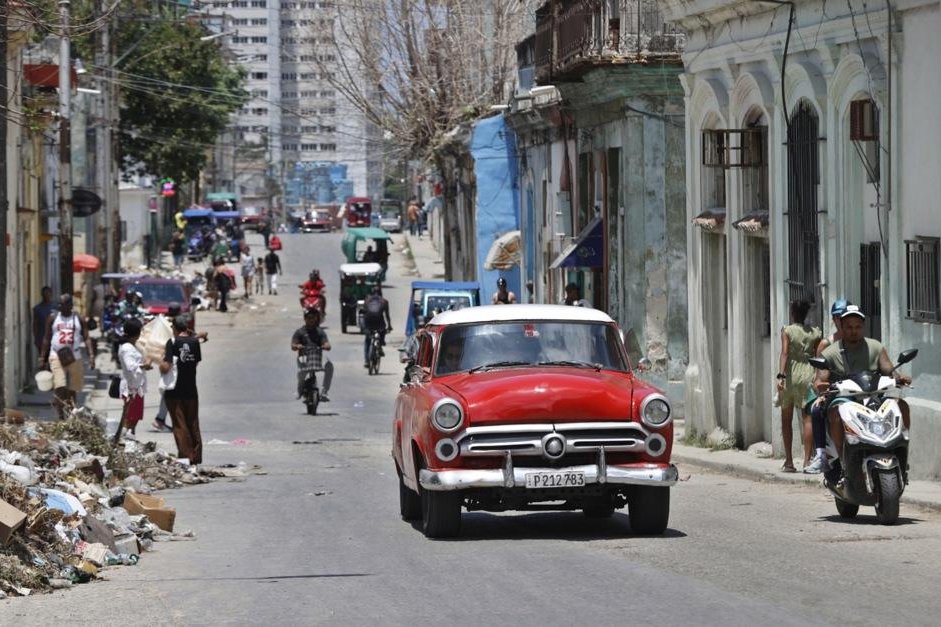
A vehicle drives down a street in Havana on Monday. Cuban President Miguel Diaz-Canel has participated in an atypical series of interviews with international media organizations over the past several weeks amid tensions with the United States. Photo by Ernesto Mastrascusa/EPA
April 21 (UPI) — The Cuban government confirmed it recently held talks with a United States delegation, following U.S. media reports that envoys sent by Secretary of State Marco Rubio traveled to the island about 10 days ago.
The confirmation came Monday from Alejandro García del Toro, a senior Cuban Foreign Ministry official in charge of U.S. affairs, during an interview with state-run newspaper Granma.
“It is a sensitive matter that, as we have said, we handle with discretion. But I can confirm that a meeting between delegations of Cuba and the United States was recently held here in Cuba,” García del Toro said, without providing a specific date.
He said U.S. participants included assistant secretaries from the State Department, while officials at the vice minister level represented the Cuban side.
García del Toro said lifting what he described as an energy blockade against Cuba was a top priority for Havana.
“This act of economic coercion is an unjustified punishment against the entire Cuban population. It is also a form of global blackmail against sovereign states, which have every right to export fuel to Cuba under the rules that govern free trade,” he said.
Washington’s restrictions on fuel supplies to Cuba, in place since January, have nearly paralyzed the country’s economy and worsened widespread power outages across the island.
Although Cuba is processing 100,000 tons of crude oil donated by Russia, diesel and other refined products derived from it will cover only about one-third of national demand for a month, according to officials from the state-run oil company Unión Cuba-Petróleo.
That supply offers temporary relief but does not resolve the country’s chronic fuel shortages, though a second tanker is on the way there, according to Russian officials.
According to a report by Fox News, the U.S. delegation presented specific demands, including expanded internet access and the release of political prisoners as initial conditions for any agreement.
A separate report by Miami Herald said U.S. officials warned their Cuban counterparts that the government has “a small window of opportunity” to reach a deal. News outlet Axios reported that Raúl Guillermo Rodríguez Castro, grandson of former President Raúl Castro, attended the meeting and played a role in initiating the talks.
García del Toro rejected those accounts, saying that during the meeting in Havana, “neither side set deadlines or issued ultimatums, as has been reported in U.S. media. All exchanges took place in a respectful and professional manner.”
On Thursday, Cuban President Miguel Díaz-Canel led a ceremony marking the 69th anniversary of the declaration of the socialist character of the Cuban Revolution, a date tied to the failed Bay of Pigs invasion by Cuban exiles backed by the United States.
At the event, Díaz-Canel said his government seeks a diplomatic solution, but he warned the country is prepared to face potential U.S. military aggression.
“The moment is extremely challenging and calls on us once again, as on April 16, 1961, to be ready to confront serious threats, including military aggression. We do not want it, but it is our duty to prepare to avoid it and, if it becomes inevitable, to win,” he said.
About the Author