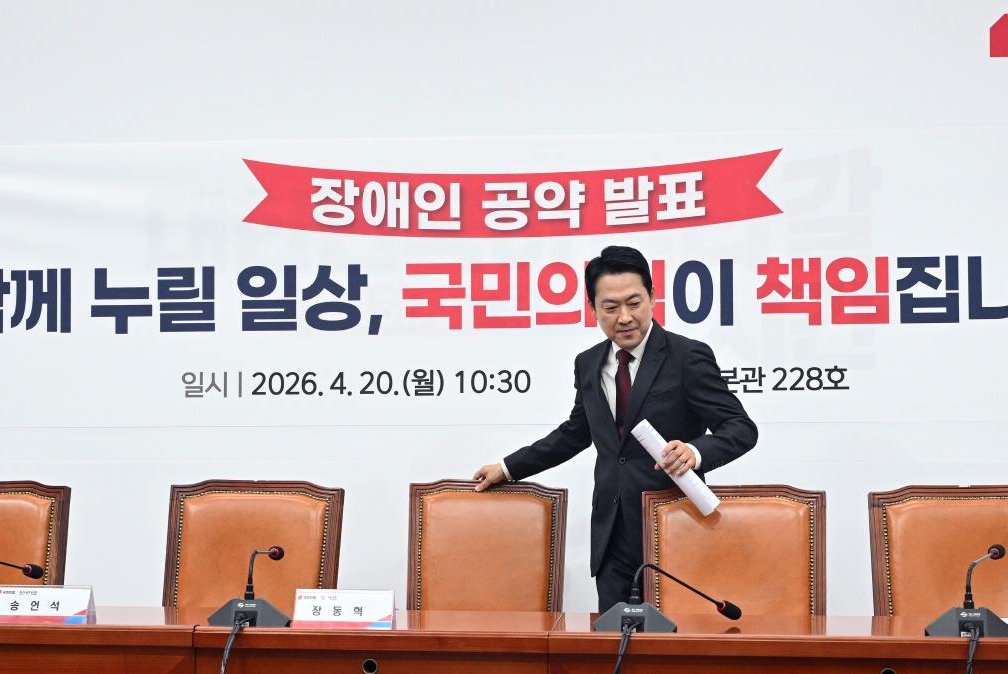
People Power Party leader Jang Dong-hyuk attends a policy event at the National Assembly in Seoul on April 20. Photo by Asia Today
April 20 (Asia Today) — The leader of South Korea’s main conservative party defended his recent U.S. visit Monday, highlighting efforts to strengthen ties with American officials while facing criticism over a lack of transparency.
Jang Dong-hyuk, head of the People Power Party, returned from an eight-day trip to the United States and said he had built networks with key figures in the Republican Party and reinforced the U.S.-South Korea alliance.
Speaking at a press briefing at the National Assembly, Jang said the visit was aimed at advancing “strategic party diplomacy” centered on national interests.
He said he established a “practical hotline” with senior U.S. Republican figures and met with officials from the White House and State Department to discuss economic and security issues, including trade.
Jang also relayed concerns from U.S. officials about regional tensions, including questions about South Korea’s stance on the conflict involving Iran and recent remarks by President Lee Jae-myung regarding Israel.
He criticized the government’s approach to North Korea, saying U.S. officials view Pyongyang’s nuclear program and recent missile launches with serious concern and are worried about communication gaps between the two governments.
Despite his claims, Jang faced criticism from political opponents and some within his party for not disclosing details of his meetings or specific outcomes, prompting accusations of “closed-door diplomacy.”
He declined to provide specifics, citing diplomatic protocol.
Jang also rejected criticism that his absence ahead of June 3 local elections was inappropriate, saying the trip itself was intended to support the party’s electoral strategy and that voters would ultimately judge the results.
The controversy has raised questions about his leadership as he seeks to position himself ahead of upcoming elections.
— Reported by Asia Today; translated by UPI
© Asia Today. Unauthorized reproduction or redistribution prohibited.
About the Author