Government ad campaign urges drivers to minimise fuel use
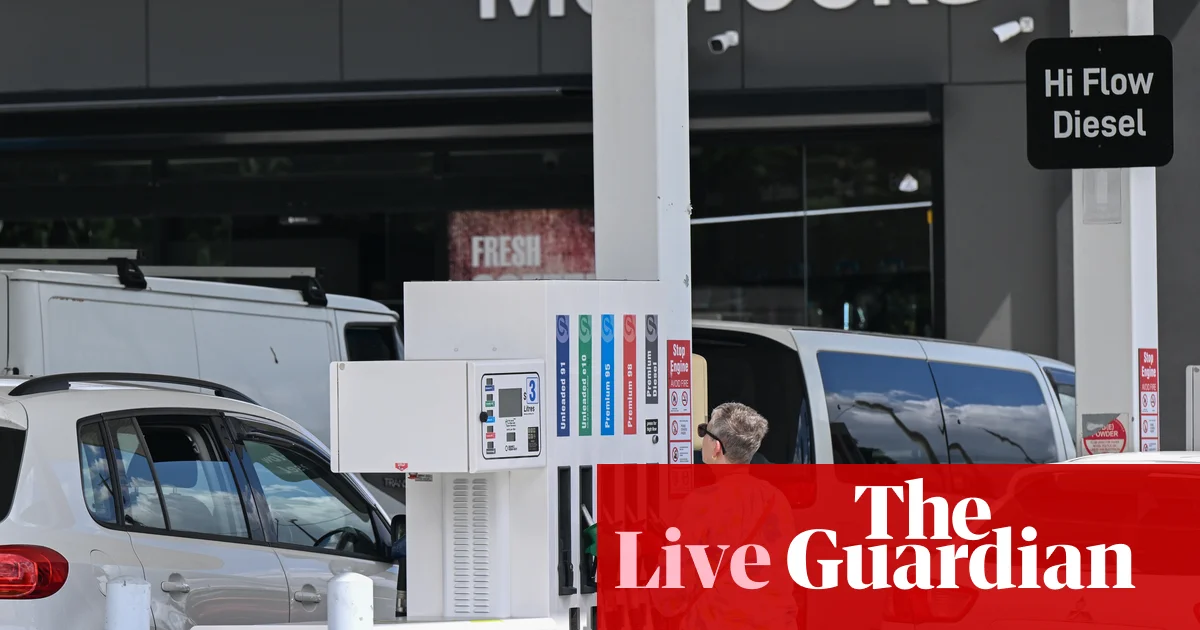
The Australian government is launching a new advertising campaign to encourage the public to minimise their use of fuel amid the global crisis caused by the US-Israel war on Iran.
The TV, digital and billboard campaign, which will begin rolling out on Monday, is called “Every little bit helps” and is part of the second level of the government’s four-tier fuel security plan.
Communication from the government overnight explains the plan as “a practical guide aimed at managing fuel supply chain pressures driven by the conflict in the Middle East”, and that level two, titled “keep Australia moving”:
double quotation mark … lays the groundwork for Australians to understand what to do now as fuel supplies hold up. It also signals that instructions will be communicated if and when we move to future levels.
The transport and infrastructure minister, Catherine King, said in a statement:
double quotation mark This campaign will help communicate the Government’s plan to the public and outline what actions they can take to help.The global fuel shortage is affecting us all and every little bit helps. From running errands in fewer trips to only filling up with the fuel you need, this will help us keep essential services moving.
The rollout of this campaign and National Fuel Security Plan ensures that we can get the public the information they need, and keep them updated if and when the situation may change.
Key events
Electric vehicle users currently don’t pay fuel excise. An alternative that has been floated is a road user charge; King said her department has been investigating what a road user charge might look like but said the government is keen not to disincentivise the uptake of electric vehicles.
She said:
double quotation mark We’ve been working within my department on the model for what a road user charge might look like. That’s no surprise to anyone. That was in the financial midyear outlook. Since December, my department has been working on that.Obviously at the moment, we’re trying to encourage as much electric vehicle uptake as we can. We don’t want to disincentivise this. So there’s a balance to be struck with the benefit, tax potential of road user charging. But we’re making our way through that.
King wouldn’t be drawn on the future of the fringe benefit tax exemption that currently benefits buyers of electric vehicles, saying it was a matter for the budget.
King has taken a swipe at Nationals leader Matt Canavan while talking about shoring up Australia’s resilience to energy shocks.
double quotation mark Whilst we talk about the need for electrification as part of the energy security, it’s also part of our economic security. I do find it passing strange, Matt Canavan, trying to take us back to the 1990s or 1980s, not understanding that the world has moved on. The world has moved on in terms of energy security.
King said the move to electrification would also require efficiency manoeuvres for some sectors that are more difficult to electrify:
double quotation mark Where there are hard to abate sectors like aviation and like some of the heavy haulage which would take a little bit longer to electrify, low carbon liquid fuels. The fact that we basically grow canola here and ship it overseas and turn it into sustainable aviation fuel and then boy it back is nuts, in our view. We should actually be having that low carbon liquid, renewable diesel. We should be able to generate that here.
Federal transport and infrastructure minister Catherine King would not be drawn on how long the federal government thinks the fuel crisis might continue, but said the government was open to considering other kinds of cost-of-living relief for the public.
King said:
double quotation mark Obviously, as we head into the budget and we get more indication of where this is going in the next months to come, whether there’s a need for additional measures. We’ve obviously got the tax cuts coming in on July 1. But whether there’s a need for additional measures for households and businesses – they’re all the things that we’re contemplating as part of the budget process.
Asked by Insiders host David Speers if the forthcoming “Every little bit helps” advertising campaign was a good use of taxpayer money in this crisis, King said:
double quotation mark I think that what the Government is trying to do is to provide as much information to people as possible. There’s a lot of anxiety, understandably, and a lot of uncertainty in the community because of what has happened with this global conflict that we are dealing with.And I think people are wanting to have information. And of course, they get that information range of sources. Whether it’s from the media, whether it’s from social media.
So the Government is building a communications platform, really, to try to provide that information to people as quickly as we can as we deal with what is, as I said, a global fuel crisis.
Federal transport and infrastructure minister Catherine King this morning has reiterated warnings that the fuel crisis may continue long after any conflict in the Middle East ceases.
Speaking to ABC’s Insiders this morning, King said the ceasefire in the Middle East at the moment is “fragile” and that the government hopes it will hold, given the Strait of Hormuz “has proven to be pretty critical to the global fuel supply, but also to global economies.”
King said:
double quotation mark We hope diplomacy works. It’s a fragile ceasefire. It’s our best chance. Even if that is the case, what we have to prepare for as a country here is even if the Strait opens tomorrow, there’s a long tail to this.We don’t know what damage has been done to infrastructure. We don’t know how quickly shipping can resume as normal or what the all of that are. So we have to plan, really, to make sure that we understand there’s a long tail to this.
We’ve been doing everything we can to shore up fuel supply, deal with issues of distribution, try to soften the blow of the fuel price hikes, which are happening globally. And we’re not party to the decisions that were made, but we are having to deal with them.
The federal energy minister, Chris Bowen, has warned of a “long tail” of fuel shortages even if the US-Israel war on Iran were to end tomorrow.
He told reporters on Saturday:
double quotation mark Even if it opened today, there’s a big backlog of ships, there’s been gas plants bombed out of existence.The international energy situation will take a long time to recover from this. This is not over.
Guardian Australia’s Josh Butler was in Singapore with Anthony Albanese, and said while the prime minister wasn’t coming back from Singapore with a shipload of diesel in his checked baggage, that didn’t mean his whistle-stop visit wasn’t a success, or that it won’t be seen in future as a pivotal moment if fuel stocks continue to be choked by the ongoing conflict in the Middle East.
Read his full analysis here:
Government ad campaign urges drivers to minimise fuel use
The Australian government is launching a new advertising campaign to encourage the public to minimise their use of fuel amid the global crisis caused by the US-Israel war on Iran.
The TV, digital and billboard campaign, which will begin rolling out on Monday, is called “Every little bit helps” and is part of the second level of the government’s four-tier fuel security plan.
Communication from the government overnight explains the plan as “a practical guide aimed at managing fuel supply chain pressures driven by the conflict in the Middle East”, and that level two, titled “keep Australia moving”:
double quotation mark … lays the groundwork for Australians to understand what to do now as fuel supplies hold up. It also signals that instructions will be communicated if and when we move to future levels.
The transport and infrastructure minister, Catherine King, said in a statement:
double quotation mark This campaign will help communicate the Government’s plan to the public and outline what actions they can take to help.The global fuel shortage is affecting us all and every little bit helps. From running errands in fewer trips to only filling up with the fuel you need, this will help us keep essential services moving.
The rollout of this campaign and National Fuel Security Plan ensures that we can get the public the information they need, and keep them updated if and when the situation may change.
Good morning, welcome to the Australian news live blog for this Sunday 12 April. My name is Stephanie Convery and I’ll be with you until this afternoon.
First up, the Australian government has launched an advertising campaign with the aim of encouraging the public to minimise their use of fuel amid the shortages caused by global supply chain disruption.
The transport and infrastructure minister, Catherine King, said the campaign would “help communicate the government’s plan to the public and outline what actions they can take to help”. More on that shortly.
And while the prime minister, Anthony Albanese, has inked a deal with Singapore to maintain mutual fuel supplies between the nations, the federal energy minister, Chris Bowen, has warned of the “long tail” of fuel supply disruptions even if the conflict in the Middle East were to end soon.
Grab yourself a coffee and let’s get stuck into it.
About the Author