
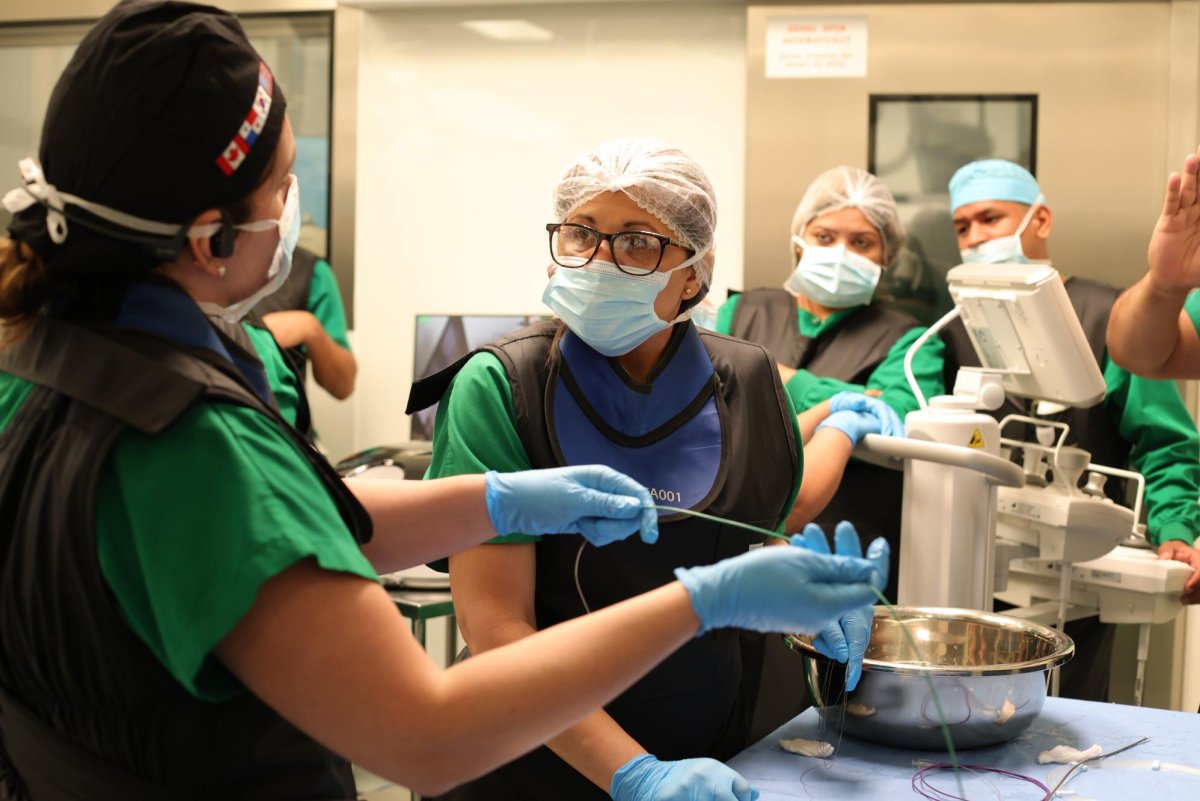
1 of 2 | Panamanian doctors are shown being trained in the remote robotic procedure to treat stroke. Photo courtesy of XCath
March 24 (UPI) — A procedure performed in Panama using remote robotic surgery to treat a stroke is generating interest among specialists, who say the technology could expand access to critical treatments by letting experts operate without being at a patient’s hospital.
The advance targets a structural limitation of the healthcare system: many centers lack highly trained neurointerventionists, even if they have medical infrastructure, which forces the transfer of patients or specialists and creates critical delays in emergencies.
The case, developed as part of the Operation Robo Angel clinical study by the company XCath, consisted of a telerobotic mechanical thrombectomy — a procedure to remove a clot from a blood vessel — in a patient in his late 60s.
The procedure was performed at The Panama Clinic in Panama City, while the neurosurgeon operated remotely from Santiago, more than 124 miles away.
According to the company, the surgeon removed the clot on the first attempt and restored blood flow to the brain within minutes. The patient woke up speaking and showed significant recovery in subsequent hours.
The neurosurgeon who performed the intervention, Vitor Mendes Pereira, highlighted the impact of the advance on access to care.
“Today, geography is no longer a death sentence. For years, I have seen how two patients with the same condition have completely different outcomes just because of where they are. This advance shows that this can change,” he said.
Independent experts said the main value of this technology lies in its potential to reduce gaps in access to highly specialized treatments.
“I think this is a landmark case in the history of surgery. Stroke care is one of the most underserved areas globally,” Vipul Patel, executive director of the Illinois-based Society of Robotic Surgery, told UPI.
Adnan H. Siddiqui, CEO and chief medical officer of the Jacobs Institute in New York state, told UPI that a large proportion of patients with the most severe types of stroke do not receive treatment — at least in time.
“The vast majority of patients with large vessel occlusions receive no therapy due to a lack of specialists or access to thrombectomy centers. This occurs not only in developing countries, but also in the United States,” Siddiqui said.
“Remote thrombectomy has the real potential to change that, bringing a highly effective and life-saving therapy closer to patients.”
Siddiqui emphasized that time remains the most critical factor in these cases.
“If we can reopen the cerebral vessel within two hours from onset, there is a 90% probability of functional independence, which drops to 30% at six hours. This innovation makes it possible to massively reduce the impact of treatment delays,” he said.
Demetrius Lopes, director of cerebrovascular surgery at Advocate Health in Chicago, said this type of intervention can help overcome structural limitations in the healthcare system.
“Remote robotic intervention is a way to address many of the current barriers in access to neurovascular procedures, especially in time-sensitive conditions such as stroke,” he said.
“We have seen that robotic neurointervention is safe and has the potential to improve the precision and efficiency of procedures, which will likely translate into better outcomes for patients.”
From XCath, CEO Eduardo Fonseca framed the procedure as part of a broader shift in medical practice.
“This is, above all, a story about life. It is about saving people. Today, we are demonstrating that technology can change history,” he said.
Fonseca said the goal is to expand access to this type of intervention.
“Our commitment is to make this technology reach every patient who needs it, regardless of where they are,” he said.
The case in Panama builds on previous developments carried out in the country, including procedures in patients with aneurysms within clinical research, which made it possible to advance toward this type of intervention in real emergency situations.
Strokes remain one of the leading causes of death and disability worldwide. Each year, they cause more than 5 million deaths and leave another 5 million people with severe disability, according to the World Health Organization.
About the Author