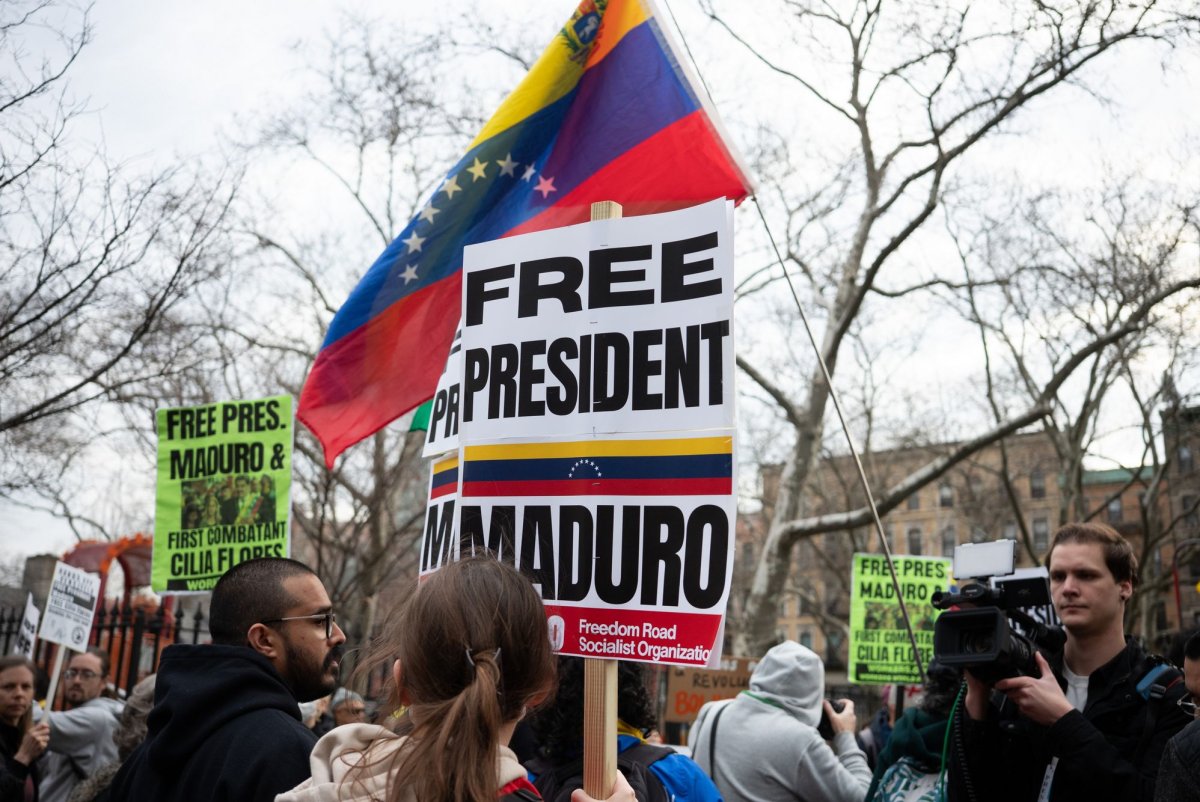
March 26 (UPI) — A federal judge refused to dismiss the case against ousted Venezuelan president Nicolas Maduro and his wife Cilia Flores in a Manhattan court Thursday.
Maduro’s attorney argued that the case should be dismissed because the Department of Treasury was refusing to allow Maduro to pay his lawyer with funds from the Venezuelan government.
“I’m not going to dismiss the case,” Judge Alvin Hellerstein said.
But he questioned the need for sanctions now that the Maduros are in custody.
“I see no abiding interest in national security in the right to defend yourself,” Hellerstein said. “The right to defend is paramount.”
Maduro said in a sworn declaration: “I understand that the government of Venezuela is prepared to fund my legal defense and it is my expectation that it will. I have relied on this expectation and cannot afford to pay for my own legal defense.”
Maduro’s lawyer, Barry Pollack, said the Treasury Department’s Office of Foreign Assets Control granted then revoked a license that would allow Maduro to pay his legal fees. The Maduros and the Venezuelan government are sanctioned by the United States. That means anyone who wants to receive payment must get a license to do so legally.
Prosecutor Kyle Wirshba argued that Maduro shouldn’t be allowed to use Venezuelan government money because he was accused of taking the government’s wealth.
“A defendant has no right to spend a third party’s money,” Wirshba said.
The judge agreed that a public defender would not have the resources to handle the case.
“Truthfully, we have no case like this,” Hellerstein said.
Hellerstein said he will consider the sanctions issue and release a decision later.
President Donald Trump said at a Cabinet meeting Thursday morning that he hoped more charges would come against Maduro.
“I hope that charge will be brought at some point,” Trump said. “He emptied his prisons into our country and was a major purveyor of drugs coming into our country. … I would imagine there are other trials coming,” Trump said.
Venezuela’s ruling party expressed solidarity with the Maduros in a statement published during their court hearing, calling for the defense of their “legitimate rights,” CNN reported.
Supporters rallied at Bolívar Square in Caracas demanding their release.
Some Venezuelans demonstrating outside the courtroom in New York told CNN they hoped Maduro would be punished and were offended by protesters demanding his freedom.
The hearing was originally scheduled by Hellerstein to allow lawyers time to review evidence and possibly set a trial date. But Pollack said last month that he will have to withdraw because the U.S. government won’t allow the Venezuelan government to pay his legal fees. Pollack said the Maduros do not have any money.
Maduro and Flores, were captured by the U.S. government in early January. They were taken to New York and charged on federal drug trafficking and weapons charges. The U.S. government then installed Delcy Rodriguez as the new president of Venezuela.
Since then, Maduro has been held at the Metropolitan Detention Center in Brooklyn in a unit that gives him “special administrative measures.” The SAMs unit doesn’t allow him access to the outside world and keeps him isolated, CBS News reported. Flores is in a different unit in the same facility.
Pollack argued that not allowing him to pay his fees is a violation of Maduro’s constitutional right to defend himself. Flores’ lawyer has joined the motion.
Prosecutors have said the initial license was an “administrative error” and the Maduros can still use their personal funds.
“OFAC, however, has denied the defendants’ request for an additional exception: to allow them to pay their legal fees from a slush fund controlled by a sanctioned government. That is because OFAC regulations expressly prohibit using a sanctioned entity’s funds to pay a separate sanctioned person’s attorneys’ fees,” prosecutors wrote in a court filing.
Duncan Levin, a former prosecutor who specializes in sanctions law, told CNN that Maduro would still be entitled to a court-appointed attorney.
“Because he is not recognized as the leader of Venezuela and the whole sanctions regime is meant to cut him off, it’s unlikely that the court is going to feel that he’s entitled to any of the money to help fund his criminal defense,” Levin said.
Pollack has also said he intends to challenge the legality of Maduro’s arrest because he was president at the time of the alleged crimes.
“Under the U.S. Constitution, it’s the president who gets to determine who to recognize as head of state, and I am 100% certain a U.S. court is not going to second guess a U.S. determination that Maduro is no longer head of state,” William Dodge, an international law professor at George Washington University’s law school, told CNN.
“Snatching him was illegal under international law,” he said, but “it’s quite well established in the U.S. the illegality of bringing someone into court doesn’t affect the jurisdiction of the court.”
Dodge added: “Drug trafficking isn’t an official act.”
About the Author