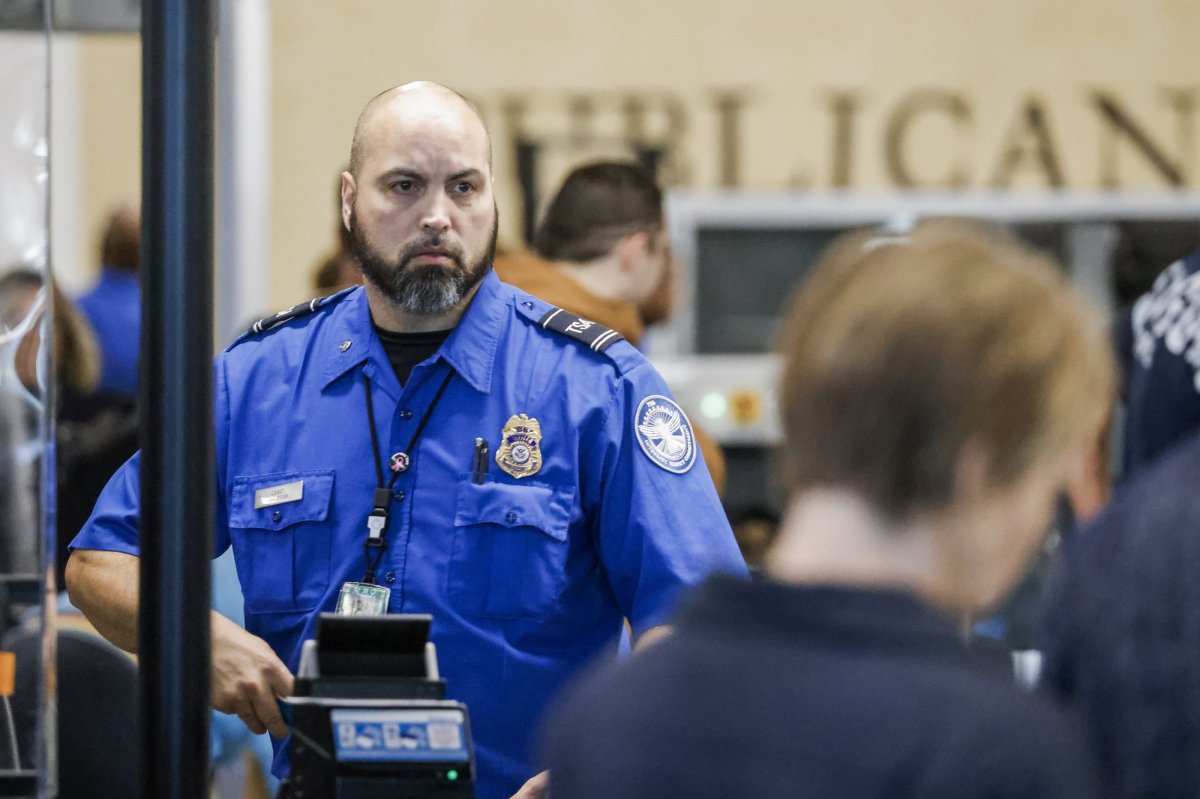
March 27 (UPI) — The U.S. Department of Homeland Security announced Friday that Transportation Security Administration employees will begin receiving paychecks as the department’s shutdown continues.
There was movement on Capitol Hill toward ending the shutdown and partially funding DHS on Friday. After the Senate unanimously voted to pass a bill that would fund the department, aside from Immigrations and Customs Enforcement, the U.S. House rejected the bill outright.
House Speaker Mike Johnson, R-La., said the House will pursue its own bill that would fully fund the department for 60 days. Johnson said the Senate’s bill would not move forward because it did not include funding for ICE.
President Donald Trump was also critical of the Senate-passed bill, saying it “wasn’t appropriate.” He signed an executive order to direct payment toward the more than 60,000 TSA employees.
“Today, at the direction of President Trump and the Secretary of Homeland Security Markwayne Mullin, TSA has immediately begun the process of paying its workforce,” a DHS spokesperson said in a statement to UPI. “TSA officers should begin seeing paychecks as early as Monday, March 30.”
Alan Fyall, associate dean of the University of Central Florida’s Rosen College of Hospitality Management, told UPI that news of TSA receiving pay is welcome, though for some it may be too late.
“If they’re going to get paid, that’s excellent,” Fyall said. “I’m sure there are quite a few who have left and probably won’t return.”
As of Friday, TSA agents were on their second pay period without receiving a paycheck.
On Wednesday, Ha Nguyen McNeill, deputy administrator of the TSA, told the House Homeland Security Committee that more than 480 workers have resigned and workers have missed $1 billion in pay.
“Most people in lower to middle salaries, if you miss two paychecks, that’s a problem,” Fyall said. “That’s not unique to TSA agents. As they would say, ‘do the math.'”
This is the second time the government has at least partially shut down, affecting the pay of TSA workers, in the past six months. The TSA has been shut down for more than 85 days this fiscal year.
“Many of our workforce have missed bill payments, received eviction notices, had their cars repossessed and utilities shut off,” McNeill told the House committee. “Some are sleeping in their cars, selling their blood and plasma and taking on second jobs to make ends meet.”
When the shutdown ends, Diego Bufquin, professor of practice at the Freeman School of Business at Tulane, told UPI he expects relief to come to TSA workers and travelers quickly, though the end of spring break adds to the long lines.
“We’re not going to have this resolved by this weekend,” Bufquin said. “Lines are going to be very long this weekend. There will be lots of complaints from passengers for sure.
“The thing is that the job market right now is not looking fantastic either,” Bufquin said. “I don’t think those TSA agents who are now considering switching jobs are in a good spot to easily find jobs in other sectors, given the current job market.”
Fyall said that the air travel industry as a whole is “resilient,” though the repeated government shutdowns will cause some travelers to change their habits, opting for direct flights when possible.
“If it’s a one-off, everybody complains but life gets back to normal pretty quickly,” Fyall said. “One of the things about the long queues is you might be waiting 3 or 4 hours, but that tells you that they’re doing their job properly. You want to get on your plane and be secure.”
About the Author