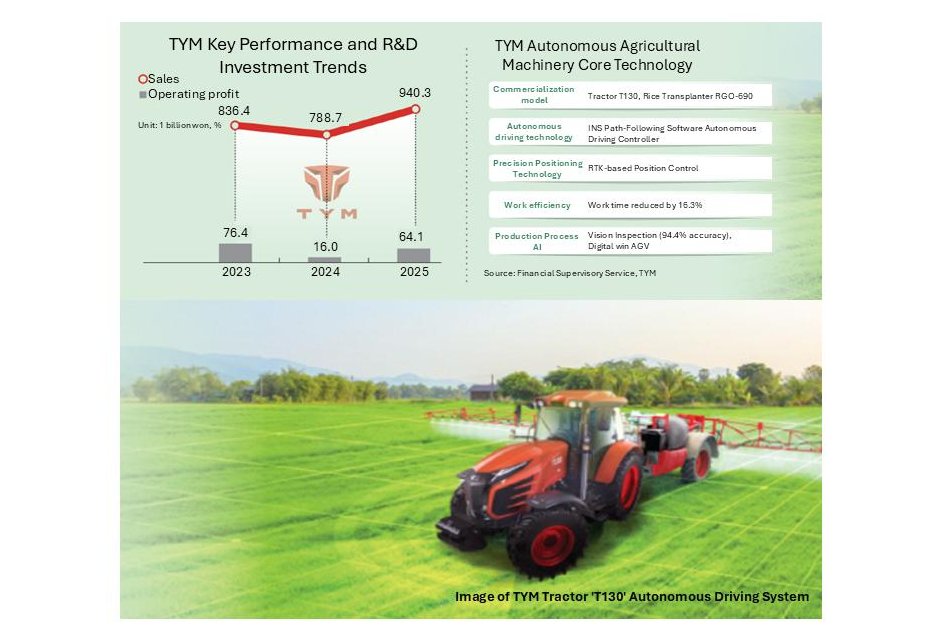
Graphic showing TYM’s performance trends and core technologies for autonomous agricultural machinery, including the T130 tractor and RGO-690 rice transplanter, along with an image of the T130 autonomous tractor in operation. Graphic by Asia Today and translated by UPI
March 5 (Asia Today) — South Korean agricultural machinery manufacturer TYM is accelerating its push into smart farming with artificial intelligence and autonomous driving technology, aiming to address labor shortages and aging rural populations.
Autonomous agricultural equipment currently accounts for about 5% of TYM’s total revenue, according to company data reviewed Wednesday. The company plans to launch three additional tractor models equipped with autonomous driving systems this year and gradually expand the technology across its full product lineup.
TYM has already commercialized two autonomous machines – the T130 tractor and the RGO-690 rice transplanter – which became the first agricultural machines in South Korea to receive national certification after passing government performance tests for autonomous operation.
The technology was developed by TYMICT, TYM’s subsidiary specializing in advanced agricultural machinery systems. Key components include an inertial navigation system, path planning software and autonomous driving controllers developed in-house.
The RGO-690 rice transplanter uses real-time kinematic positioning technology, allowing positioning accuracy within 2 centimeters and operational accuracy within 7 centimeters.
According to the company, precision autonomous operation improves work accuracy by about three times compared with conventional machinery while reducing working time by an average of 16.3%. Reduced unnecessary straight movement and turning also improves fuel efficiency.
TYM is also integrating artificial intelligence into its manufacturing operations.
At its factory in Iksan, North Jeolla Province, the company uses an AI-based visual inspection system that automatically detects product defects with 94.4% accuracy. It has also implemented a digital twin system, which replicates factory operations in virtual space, along with automated logistics robots to increase production efficiency.
The company’s technological push is supported by rising research investment.
TYM’s research and development spending increased from 134 billion won ($100 million) in 2023 to 193 billion won ($144 million) in 2024. R&D spending as a share of revenue rose from 1.6% to 2.45%.
Financial results have also improved. The company reported revenue of 940.2 billion won ($703 million) and operating profit of 64 billion won ($48 million) last year, representing year-on-year increases of 19% and 299% respectively.
Industry analysts say autonomous agricultural equipment is gaining attention globally as countries confront shrinking rural workforces.
However, commercialization speeds may vary internationally because regulations and communications infrastructure differ by country.
Major global agricultural machinery companies – including John Deere, CNH Industrial and Kubota – are also increasing investment in autonomous equipment and smart farming technology.
TYM said it plans to strengthen its domestic market base first before expanding globally.
“We are advancing and commercializing autonomous agricultural machinery technology to reinforce our position in the domestic market,” a company official said. “Global expansion will follow gradually depending on regulatory conditions and communication infrastructure in each country.”
— Reported by Asia Today; translated by UPI
© Asia Today. Unauthorized reproduction or redistribution prohibited.
About the Author