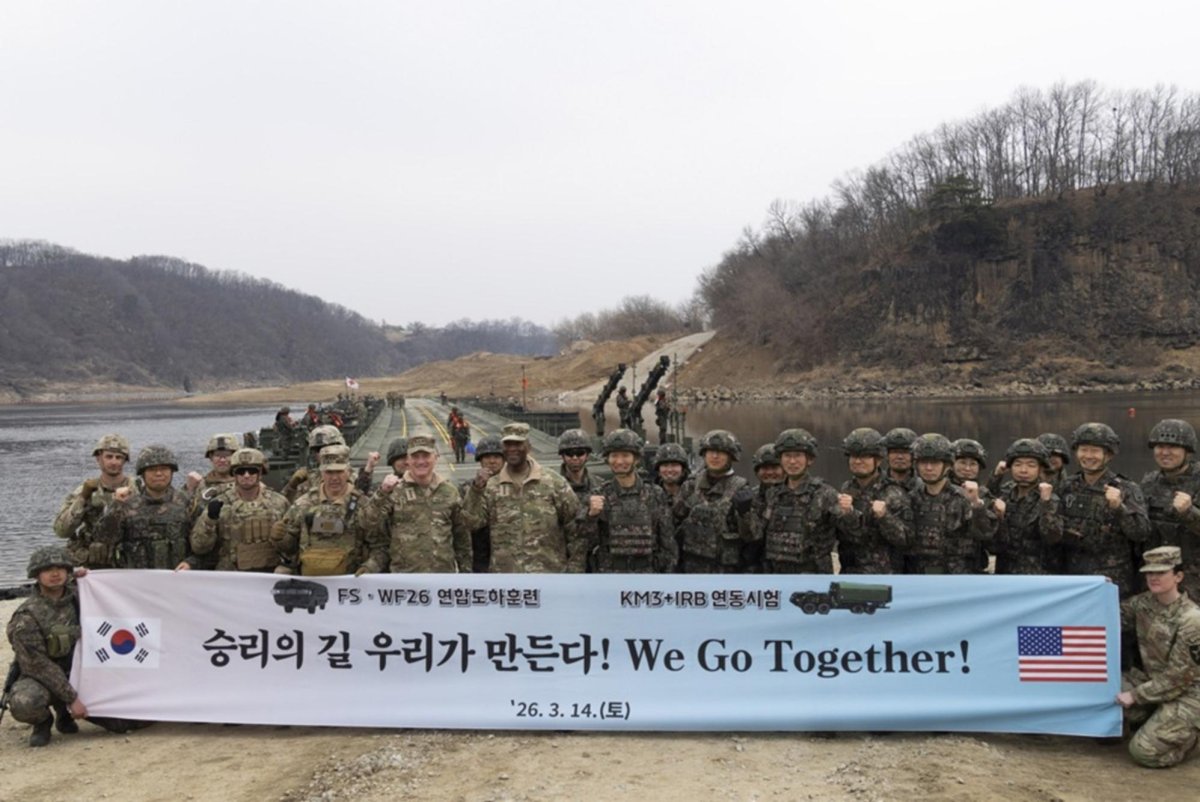
U.S. Gen. Xavier Brunson (C), chief of the South Korea–U.S. Combined Forces Command, attends a combined exercise (maneuvering, wet gap crossing) with South Korean soldiers from the Lightning Brigade, Capital Mechanized Infantry Division and 7th Engineer Brigade, as part of the Freedom Shield 26 exercise, in Yeoncheon, Gyeonggi province, South Korea, 14 March 2026. According to South Korea’s Joint Chiefs of Staff (JCS), North Korea launched ballistic missiles into the east sea on 14 March as South Korea and the United States were conducting their military exercise. Photo by JEON HEON-KYUN/EPA
March 27 (Asia Today) — The United States and South Korea have established a new joint command unit aimed at integrating nuclear and conventional forces to strengthen deterrence against North Korea, according to defense officials.
The unit, known as J10, has been set up within U.S. Forces Korea headquarters at Camp Humphreys in Pyeongtaek. It is designed to move beyond the traditional concept of a “nuclear umbrella” and enable real-time operational coordination between U.S. strategic assets and South Korean conventional forces.
Originally separated from the U.S. Forces Korea planning directorate in June 2024, J10 is led by a colonel-level commander and serves as a centralized command structure for combined nuclear and conventional operations.
Military experts said the creation of J10 marks a shift from declaratory deterrence to operational readiness, allowing faster execution of joint responses in the event of a North Korean nuclear threat.
The unit is expected to play a key role in implementing decisions made by the bilateral Nuclear Consultative Group established under the Washington Declaration, with the ability to coordinate immediate response measures from the Korean Peninsula.
J10 will oversee operational planning that aligns U.S. strategic assets – such as long-range bombers and nuclear-powered submarines – with South Korean support forces. It is also expected to match response options to specific North Korean threat scenarios to accelerate execution speed.
Previously, U.S. nuclear operations were largely managed by command structures based in the United States. The new arrangement places a dedicated coordination function on the Korean Peninsula, enabling continuous, real-time management of response planning.
Analysts said the move is intended to strengthen integration between South Korea’s “three-axis” defense system and U.S. nuclear capabilities, increasing military pressure on North Korea.
However, officials noted that the effectiveness of J10 will depend on the level of real-time intelligence sharing between the two allies.
A senior official described J10 as “the final piece” in building an integrated extended deterrence framework, adding that its capabilities will be tested in upcoming large-scale joint military exercises.
— Reported by Asia Today; translated by UPI
© Asia Today. Unauthorized reproduction or redistribution prohibited.
About the Author