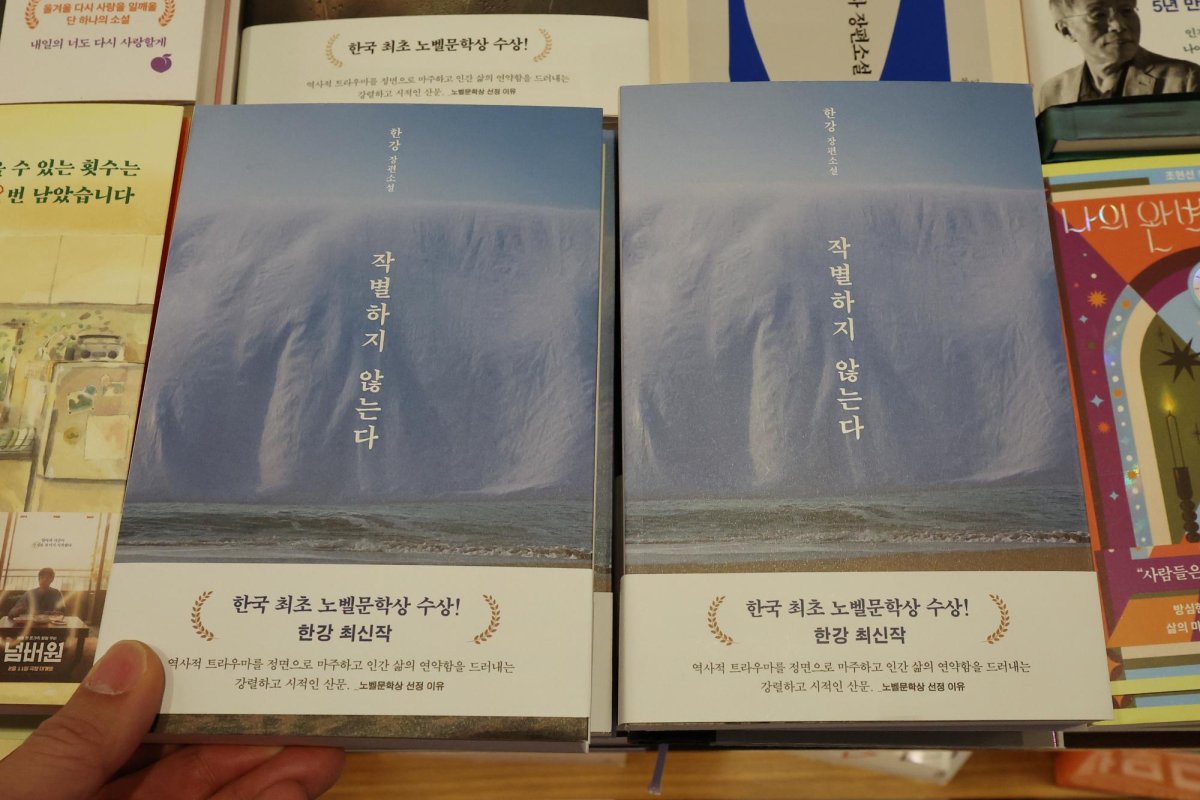
Han Kang’s “We Do Not Part” won the National Book Critics Circle prize for fiction in New York on Thursday. In this photo, the Korean-language edition is seen on display at a Seoul bookstore Friday. Photo by Yonhap
Han Kang won the National Book Critics Circle (NBCC) prize for fiction with “We Do Not Part,” further cementing her place among literature’s most vital voices following her 2024 winning of the Nobel Prize in Literature.
The celebrated South Korean author was named the winner of the prestigious American literary award for the 2021 novel published in English translation in 2024, at the NBCC’s annual awards ceremony held in New York on Thursday night (U.S. time).
Heather Scott Partington, the NBCC’s fiction committee chair, described the book as “a work of blinding melancholy, bleak weather, and murmuring syntax,” while onstage before presenting the award.
“A subtly rendered sketch of trauma in the wake of the Jeju massacre — a rumination on creation and truth amidst loss. This artful novel lingers like an atmospheric, arresting dream,” she added.
Han Kang was not able to attend the event. In her stead, David Ebershoff, vice president and editor-in-chief of Hogarth and executive editor of Random House, accepted the award and read her acceptance speech on her behalf.
Thanking everyone “who helped me while I wrote this book over seven years,” the speech read, “In this book, there are ones who have resolved not to bid farewell. Instead of an impossible farewell, they choose to stay within tenacious mourning, they light candles below the sea.”
“In the pitch-black plunge of the night, I still hope to believe in the blinking light which we have in us, and to move forward, holding it with tenacity.”
The novel addresses fragile — yet resilient — human life caught in historical trauma, portraying the tragedy of a 1948 civilian massacre on South Korea’s southern island of Jeju through the perspectives of three women.
The Jeju uprising on April 3, 1948, was a protest against U.S. military-led rule that the then government falsely labeled as a communist revolt, resulting in the deaths of tens of thousands of civilians.
The novel’s lead character, Jung-shim, appears outwardly frail and sorrowful, yet never ceases her grieving and farewells. The author has noted Jung-shim’s determination to fight until the very end forms the heart of the book, symbolizing resilience and perseverance in the face of tragic historical circumstances.
The novel’s French edition, “Impossibles adieux,” won France’s prestigious Prix Medicis for foreign literature in 2023 and the Emile Guimet Prize for Asian Literature in 2024.
Han, who made her literary debut as a poet in 1993, has spoken openly about the struggle of bringing the book to life.
“It took me seven years to finally complete the story, and when I did that, it was the happiest moment for me,” she said at a press conference on Nov. 14, 2023, marking her winning the Prix Medicis.
At that time, she wanted to explore more personal themes after writing a series of novels centered on historical events.
“I’ve had enough of feeling cold, as it snows so much in ‘We Do Not Part.’ I would like spring to come,” she said.
Reflecting on life, she added: “Lately I’ve been thinking a lot about what it means to be alive. We are given this one-off life as a gift, whether we like it or not, and must eventually return it. I want to develop the idea of being alive and write about spring.”
Established in 1976, the NBCC presents awards for the “finest books published in English” across six categories — fiction, nonfiction, biography, autobiography, poetry and criticism.
Last year, Kim Hye-soon became the first Korean to win an NBCC award, taking the poetry prize for the English translation of her collection “Phantom Pain Wings.”
Han Kang’s win marks the second consecutive NBCC honor for a Korean writer in translation and the first translated work to receive the fiction prize.
Copyright (c) Yonhap News Agency prohibits its content from being redistributed or reprinted without consent, and forbids the content from being learned and used by artificial intelligence systems.
About the Author