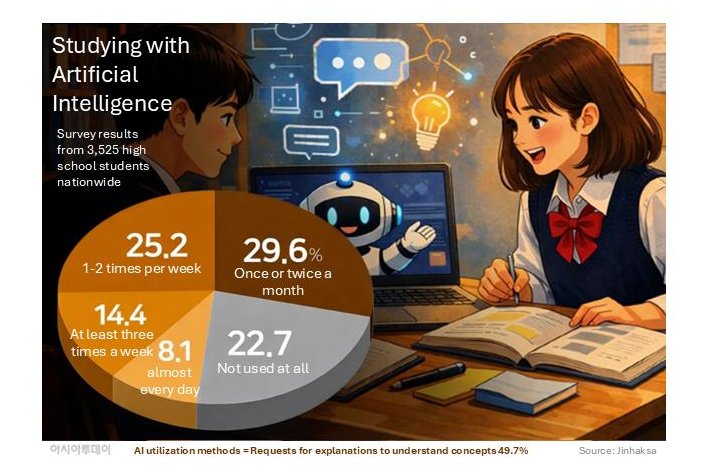
A graphic illustrates survey results showing how South Korean high school students use artificial intelligence for studying. Graphic by Asia Today and translated by UPI
March 11 (Asia Today) — Nearly half of South Korean high school students are using artificial intelligence to help them study, a survey showed, as the government moves to expand AI education in public schools.
According to a survey conducted by education company Jinaksa of 3,525 high school students nationwide, 47.7% said they use AI for studying at least once a week.
The most common usage frequency was once or twice per week at 25.2%. Another 14.4% said they use AI three times or more each week, while 8.1% reported using it almost daily.
Meanwhile, 22.7% said they never use AI for studying, and 29.6% said they use it only once or twice a month.
Students most frequently used AI to ask for explanations of unfamiliar concepts, accounting for 49.7% of responses. Other common uses included help solving problems at 29.0%, summarizing notes or reading passages at 27.9% and requesting feedback on answers at 17.4%.
The findings suggest students are not using AI simply to find correct answers but increasingly treat it as a question-based learning tool that explains concepts and helps guide problem-solving.
Education officials are also expanding artificial intelligence education in public schools.
The Ministry of Education said it has designated 1,141 elementary, middle and high schools nationwide as “AI focus schools” in cooperation with 17 regional education offices.
These schools will integrate AI-related lessons across subjects and expand interdisciplinary programs that combine artificial intelligence with existing curricula. Schools will also strengthen ethics education to encourage responsible use of AI and provide activities such as AI clubs and hands-on learning programs.
The ministry plans to gradually expand the program to 1,500 schools by 2027 and 2,000 schools by 2028.
Woo Yeon-cheol, director of the admissions strategy research institute at Jinaksa, said students are increasingly using AI as a form of “digital tutoring.”
“Students are not simply using AI to complete assignments,” Woo said. “They are using it to ask questions about concepts they do not understand and to check the direction of problem solving.”
He added that the ability to ask questions anytime and receive immediate explanations is helping AI become a new learning support tool.
Woo also noted that even as the government moves to expand AI-based education in schools, students have already been adapting quickly to AI-driven learning environments outside the classroom.
— Reported by Asia Today; translated by UPI
© Asia Today. Unauthorized reproduction or redistribution prohibited.
About the Author