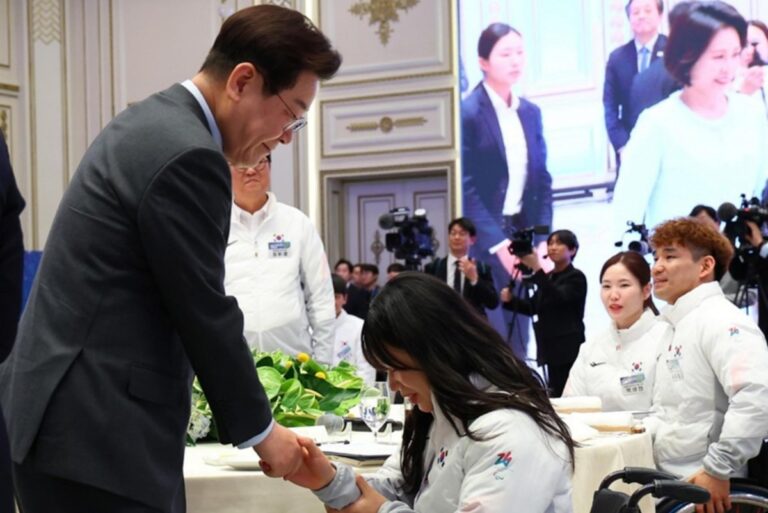
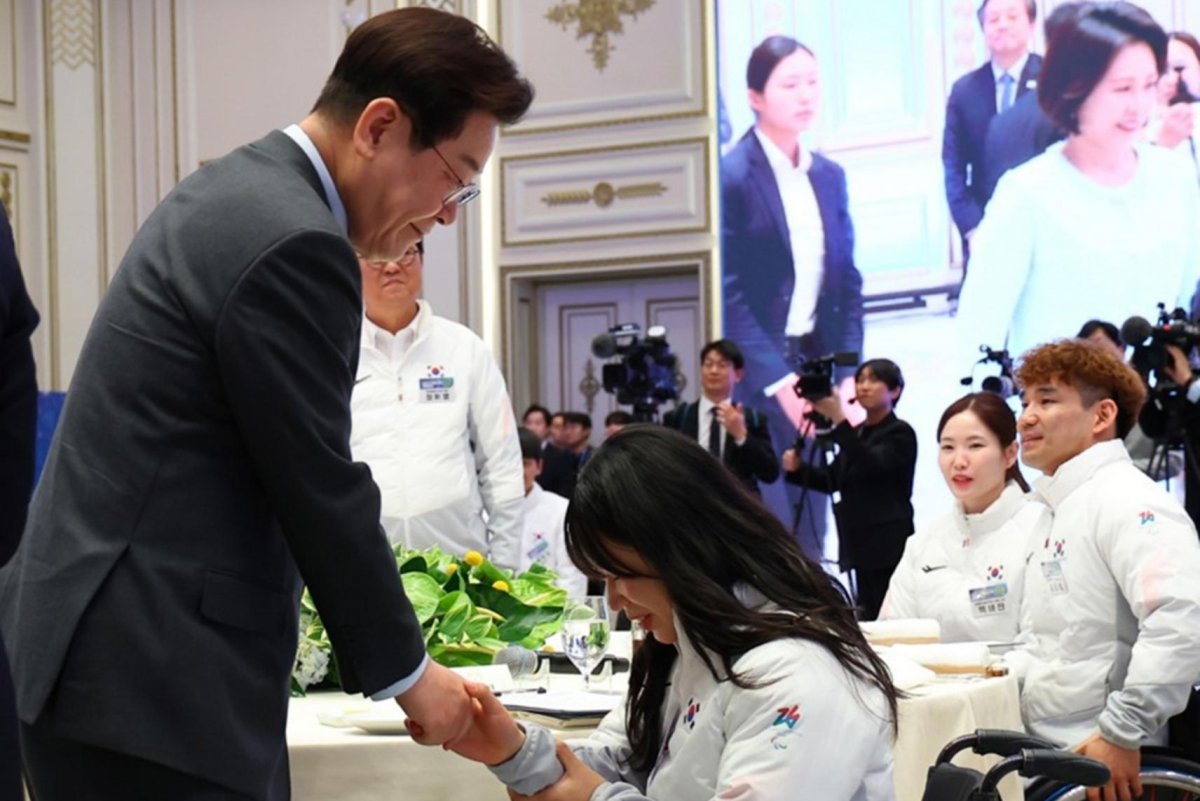
President Lee Jae-Myung (L) shakes hands with Kim Yun-jin, who won the gold medal in the cross-country skiing 20-kilometer interval start race at the Milan-Cortina Paralympic Games, during a luncheon at the presidential office Cheong Wa Dae in Seoul, South Korea, 20 March 2026. The event honors Paralympic athletes who competed in the Games. Photo by YONHAP / EPA
March 22 (Asia Today) — South Korean President Lee Jae-myung said Sunday he has ordered the exclusion of public officials who own multiple homes or high-value non-residential properties from all stages of housing and real estate policy-making.
Lee said in a post on X that such officials should be barred from discussions, drafting, reporting and approval processes, stressing the need to eliminate conflicts of interest in efforts to stabilize the housing market.
“Housing and real estate policy must not have even a 0.1% flaw or loophole,” Lee said, describing housing reform as a central task for the country’s broader transformation.
The directive comes as the government reviews additional measures to curb housing prices in the Seoul metropolitan area ahead of the May 9 expiration of a temporary tax relief measure for multi-homeowners.
Lee said there is no inherent problem with owning multiple properties, but criticized officials who design tax, financial and regulatory systems that benefit property holders and drive up prices.
“If those who created or tolerated such systems exploit them for speculation, shouldn’t they face sanctions beyond criticism?” Lee said, adding that excluding such officials from policy-making would be appropriate.
He described housing price stability as a decisive issue for his administration and the country, saying access to housing is essential for family formation and daily life.
A senior presidential official said the government is currently assessing the real estate holdings of officials involved in housing policy and plans to implement measures, including reassignment or exclusion from related duties, once the review is complete.
The move is widely seen as an effort to strengthen policy credibility and demonstrate the administration’s commitment to stabilizing the real estate market.
— Reported by Asia Today; translated by UPI
© Asia Today. Unauthorized reproduction or redistribution prohibited.
About the Author