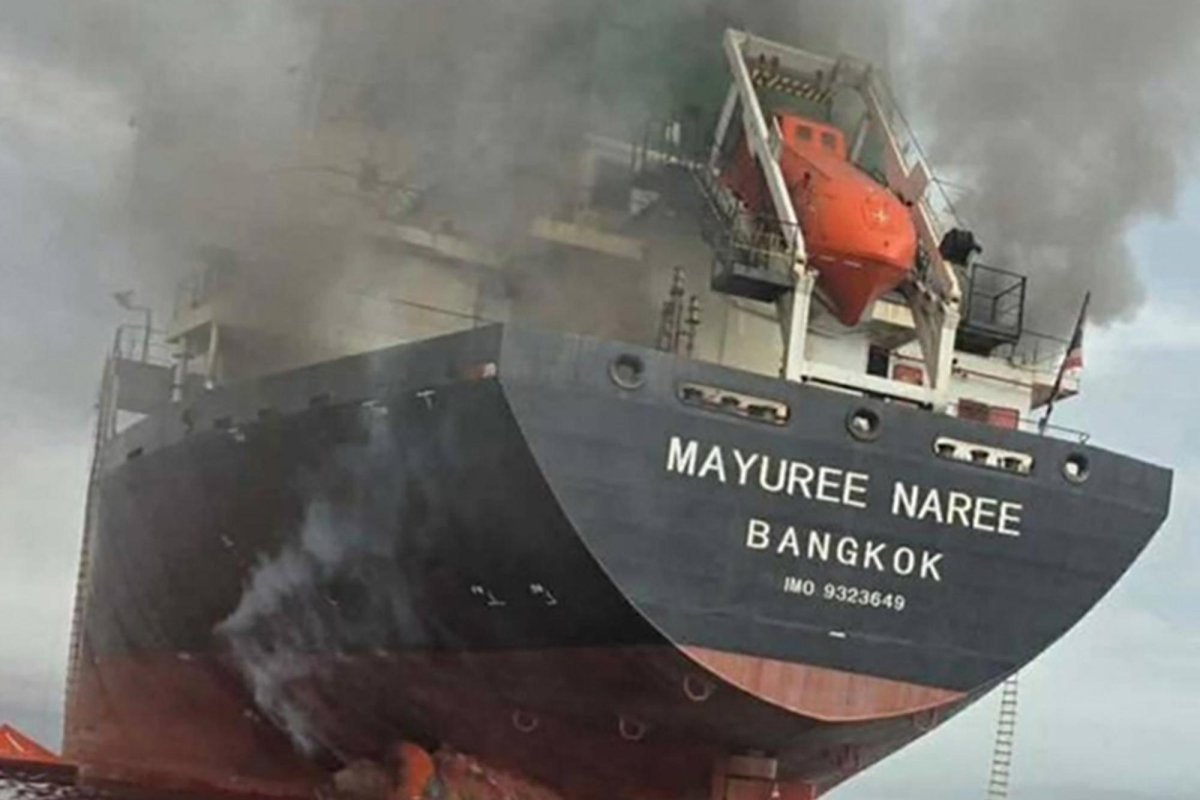
The Thai-flagged cargo ship Mayuree Naree on fire after being hit by Iranian missiles in the Strait of Hormuz, Iran, 11 March 2026. Photo by ROYAL THAI NAVY / EPA
March 17 (Asia Today) — South Korea’s heavy reliance on Middle Eastern oil passing through the Strait of Hormuz is raising concerns that a prolonged Iran-related crisis could deal a direct blow to the country’s industrial sector, a state-run research institute said.
The Korea Institute for Industrial Economics and Trade said Monday that 70.7% of South Korea’s crude oil imports come from the Middle East, with 99% of that volume transported through the strategically vital Strait of Hormuz.
The institute warned that if disruptions in the strait persist amid tensions involving Iran, the impact would extend beyond energy security to the broader real economy, particularly manufacturing.
Global oil prices have already surged more than 40% in a short period due to escalating tensions. The institute estimated that a 10% rise in oil prices would increase South Korea’s manufacturing production costs by an average of 0.71%.
“The Middle East is a key global energy production region, and any disruption in supply could have widespread effects on the global economy,” said Hong Seong-wook, a senior researcher at the institute. He noted that more than 20% of global seaborne oil shipments pass through the Strait of Hormuz, making it a critical chokepoint in global energy logistics.
South Korea imports crude oil and energy products primarily from Saudi Arabia, the United Arab Emirates, Qatar and Kuwait, all of which rely on the strait for maritime access.
The institute said potential risks include higher oil prices, supply chain disruptions, increased logistics costs and heightened financial market volatility. Energy-intensive industries such as petrochemicals, refining, rubber and plastics are expected to be most affected.
However, the report noted that the direct impact on exports to the Middle East would likely be limited. Shipments to the region account for about 2% to 3% of South Korea’s total exports, and the share going specifically to countries near the strait is even smaller.
Still, a prolonged disruption could force companies to seek alternative shipping routes, such as ports in Oman or overland transport, which would increase costs and delivery times.
The institute urged the government to strengthen energy supply chain resilience, manage logistics risks and prepare policy responses to stabilize financial markets. It also warned of potential stagflation if high oil prices persist alongside slowing economic growth.
— Reported by Asia Today; translated by UPI
© Asia Today. Unauthorized reproduction or redistribution prohibited.
About the Author