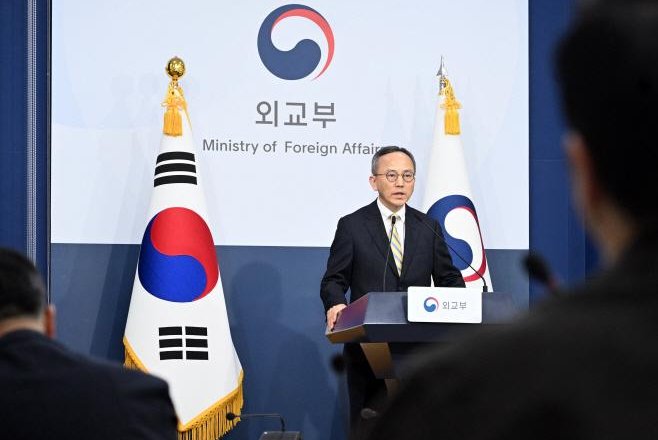
Park Il, spokesperson for South Korea’s Foreign Ministry, speaks during a briefing at the government complex in Seoul. Photo by Asia Today
April 5 (Asia Today) — South Korea said conditions differ by vessel and country for ships navigating the Strait of Hormuz, as Seoul works with international partners to address disruptions caused by the ongoing blockade.
The Foreign Ministry said Sunday that recent cases of French- and Japanese-linked vessels passing through the strait reflect varying circumstances, including ownership, cargo type, destination and crew nationality.
“The government prioritizes the safety of vessels and crew and takes into account the position of shipping companies,” the ministry said, adding that it is coordinating with relevant countries to ensure freedom of navigation under international norms.
The remarks follow renewed attention on Seoul’s response after several foreign vessels successfully transited the strait despite the blockade.
A container ship linked to a French operator crossed the waterway Wednesday, marking the first such passage by a Western European-related vessel. A day later, a Panama-flagged liquefied natural gas carrier operated by a Japanese shipping company also passed through, followed by an Indian-flagged tanker connected to the same firm. The Japanese government said it was not involved in those transits.
Seoul is pursuing a multilateral approach rather than direct negotiations with Iran, citing concerns that bilateral talks could expose companies to demands for transit fees that may conflict with international rules.
Officials said developments in U.S.-Iran contacts and broader diplomatic efforts, including meetings led by Britain, are being closely monitored as part of that strategy.
At the same time, the government acknowledged that private shipping companies’ decisions will be critical. If companies seek to resolve passage issues independently – including by paying fees – Seoul may be forced to become involved.
The ministry said communication channels with Iran remain open.
Tensions escalated after U.S. and Israeli strikes on Iran in late February triggered Tehran’s move to block the strait, a key global energy route. South Korea currently has 26 vessels stranded in the area, with about 180 crew members on board.
— Reported by Asia Today; translated by UPI
© Asia Today. Unauthorized reproduction or redistribution prohibited.
About the Author