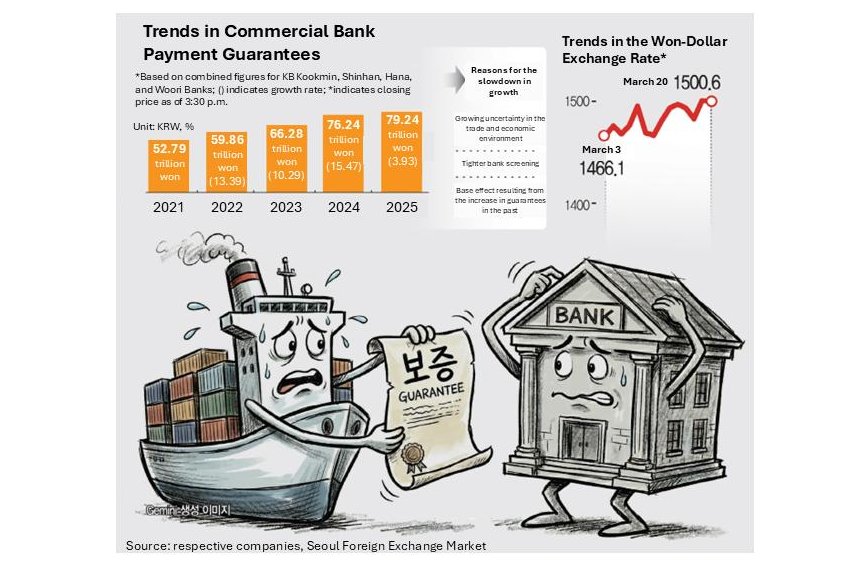
An illustration shows slowing growth in South Korean banks’ payment guarantees alongside a rising won-dollar exchange rate. Graphic by Asia Today and translated by UPI
March 22 (Asia Today) — South Korea’s four largest banks are tightening corporate payment guarantees as exporters face mounting pressure from U.S. tariffs and a prolonged period of high exchange rates.
The combined value of guarantees issued by KB Kookmin Bank, Shinhan Bank, Hana Bank and Woori Bank reached 79.2 trillion won (about $59 billion) at the end of last year, up 3.9% from a year earlier, according to financial industry data.
The increase marks a sharp slowdown compared with double-digit growth in previous years, reflecting a more cautious approach by banks amid rising economic uncertainty.
Banks have scaled back new guarantees as U.S. tariff policies weigh on export profitability and a weaker won raises costs for companies. The won-dollar exchange rate has hovered around 1,500 won, adding further pressure on corporate balance sheets.
Payment guarantees, commonly used by exporters, allow companies to secure financing or complete trade transactions by relying on a bank’s credit backing. If a company defaults, the bank assumes the repayment obligation.
Industry data show that firm guarantees – where the amount is fixed and the bank assumes the debt – rose 8.5% to 60.9 trillion won (about $45 billion), while contingent guarantees fell 8.8% to 18.3 trillion won (about $13.7 billion).
Analysts said banks are favoring lower-risk transactions and reducing exposure to more complex contingent guarantees, which are harder to manage.
The slowdown also reflects weaker demand. Large exporters, which drove much of last year’s trade growth, often do not require bank guarantees, while rising delinquency risks have prompted lenders to focus on balance sheet stability.
Looking ahead, growth in guarantees is expected to remain subdued as geopolitical tensions in the Middle East and global logistics disruptions continue to weigh on trade.
A prolonged period of high exchange rates could further increase risks, as most guarantees are denominated in foreign currencies, meaning their value rises in won terms even without new issuance.
Experts say stabilizing the foreign exchange market and expanding trade finance support will be key to preventing broader financial strain on companies.
— Reported by Asia Today; translated by UPI
© Asia Today. Unauthorized reproduction or redistribution prohibited.
About the Author